

The complete guide
Desk Bells Buying Guide, How To Choose A First Bell Set For A Child
The problem with most first instruments
Buy a child a small keyboard and watch what happens. They press keys at random, the demo song plays itself, and within a week the thing is under the bed. The reason is not short attention spans. It is that the instrument asks too much too early. A keyboard has 30 or more keys, no obvious starting point, and a long gap between pressing something and making music.
Desk bells close that gap. There are eight of them. Each one makes exactly one note. You press the top and it rings. A three year old can produce a clean, in-tune musical sound on the first attempt, which almost never happens with a recorder, a ukulele or a keyboard. That first success is what keeps a child coming back, and coming back is the only thing that turns a toy into a skill.
How a desk bell works
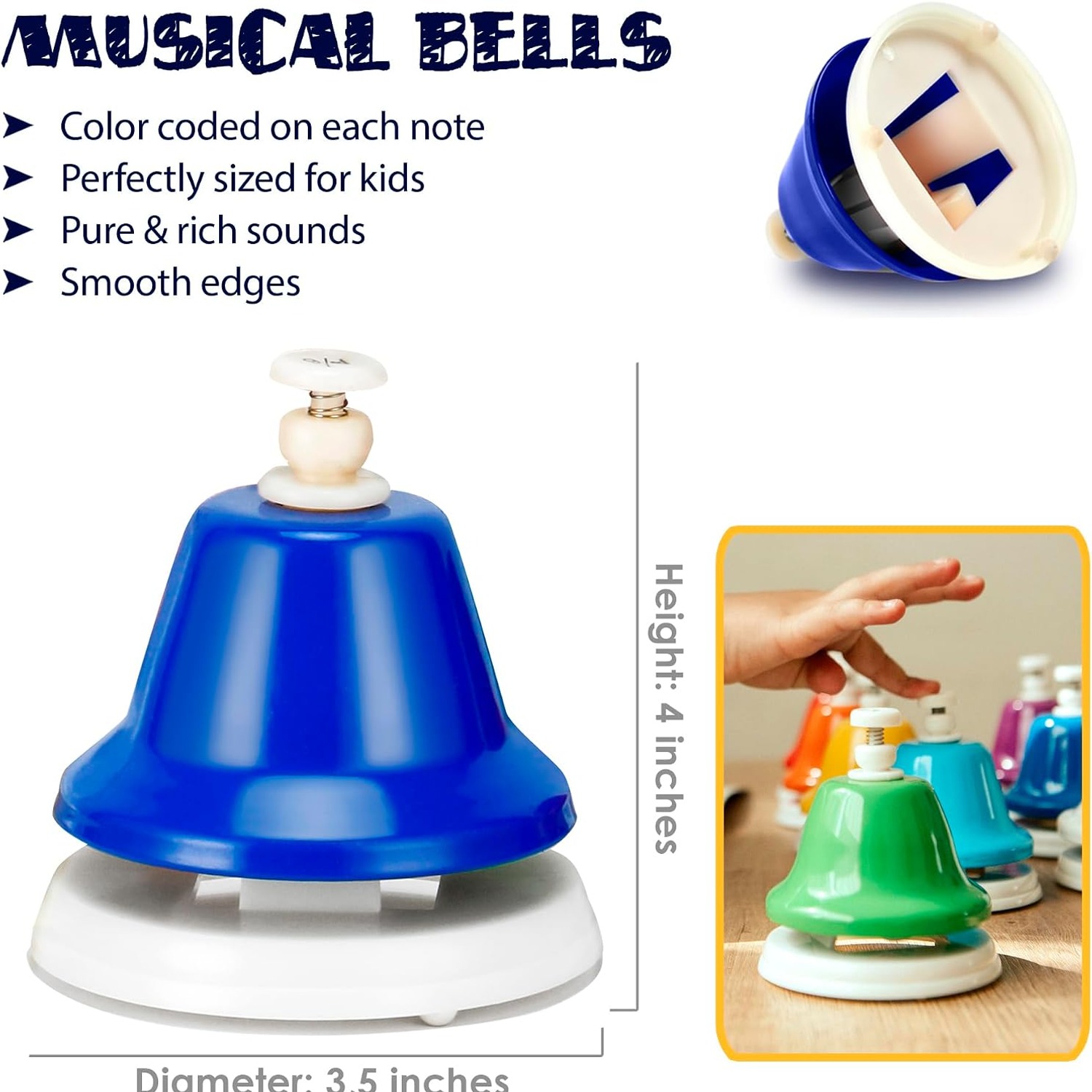
Inside each bell is a small metal mechanism. Pressing the plate on top drives a clapper against the sounding part, which produces a single pitch and then fades. There is no shaking, no swinging, no technique to learn. Hand position does not matter. Grip strength barely matters. A palm will do it, and so will one finger.
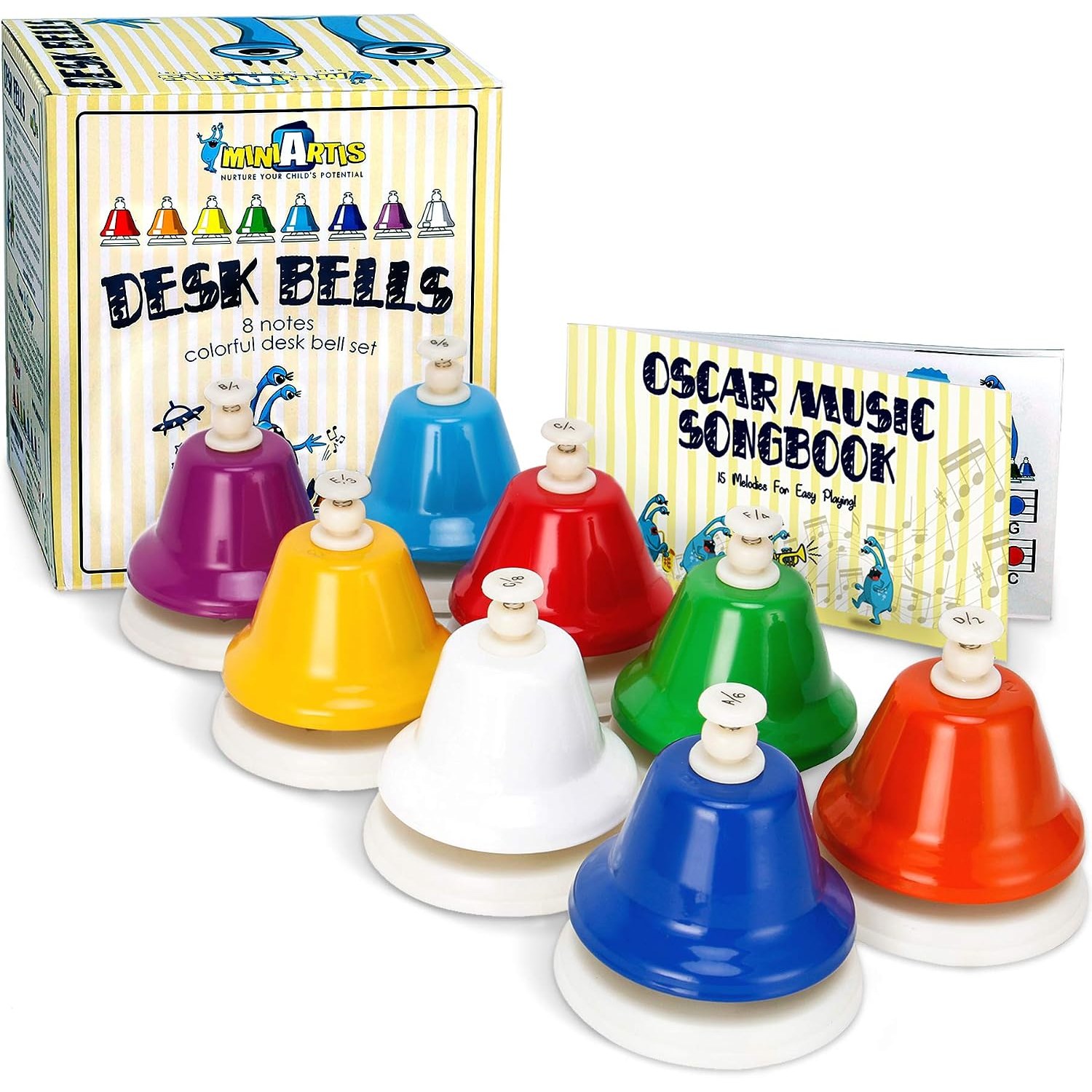
This set has eight bells tuned to C, D, E, F, G, A, B and C. In plain terms that is do-re-mi-fa-so-la-ti-do, the ladder nearly every nursery song sits on. Because the top C is the same note as the bottom C an octave higher, songs that reach for that final note end where they should rather than running out of bells.
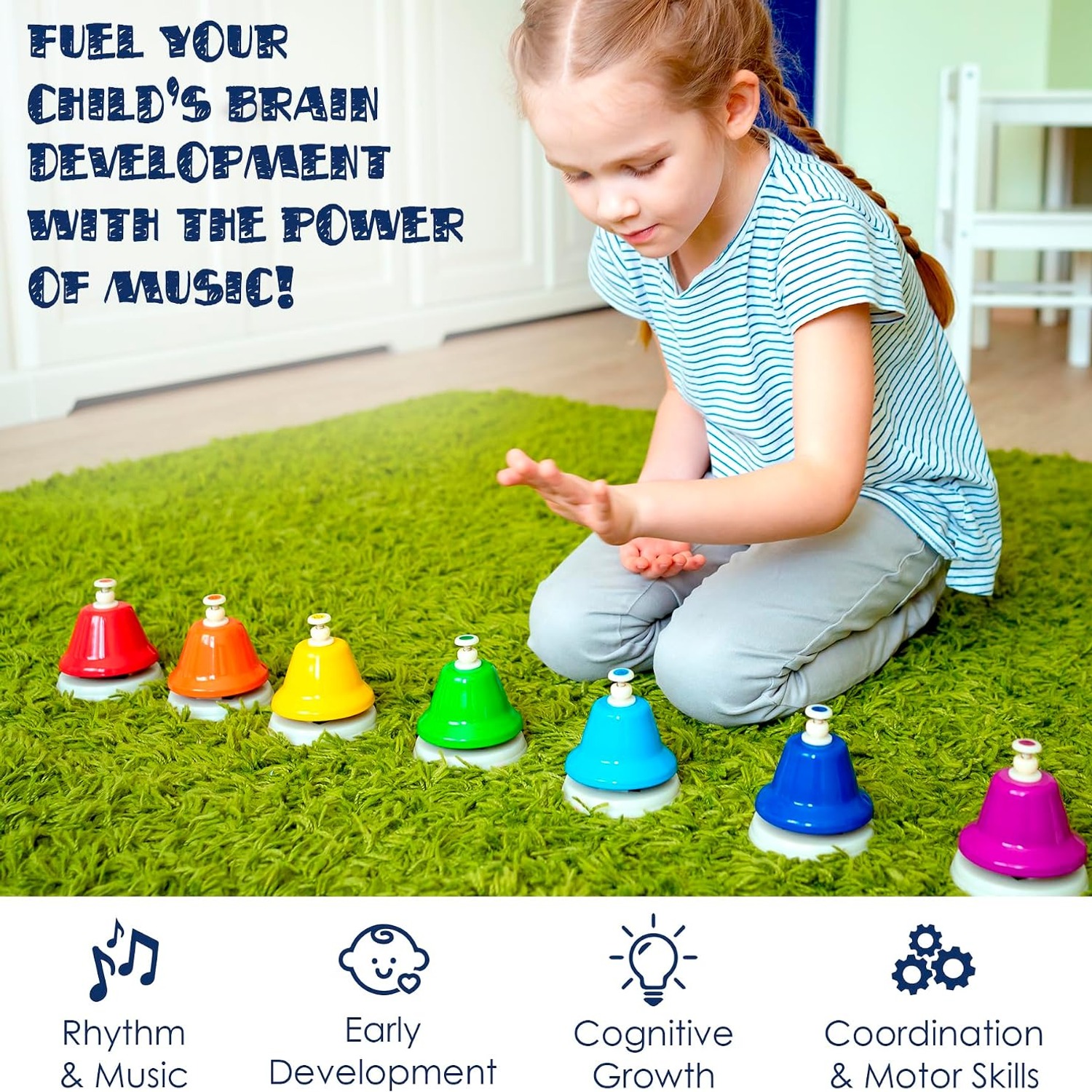
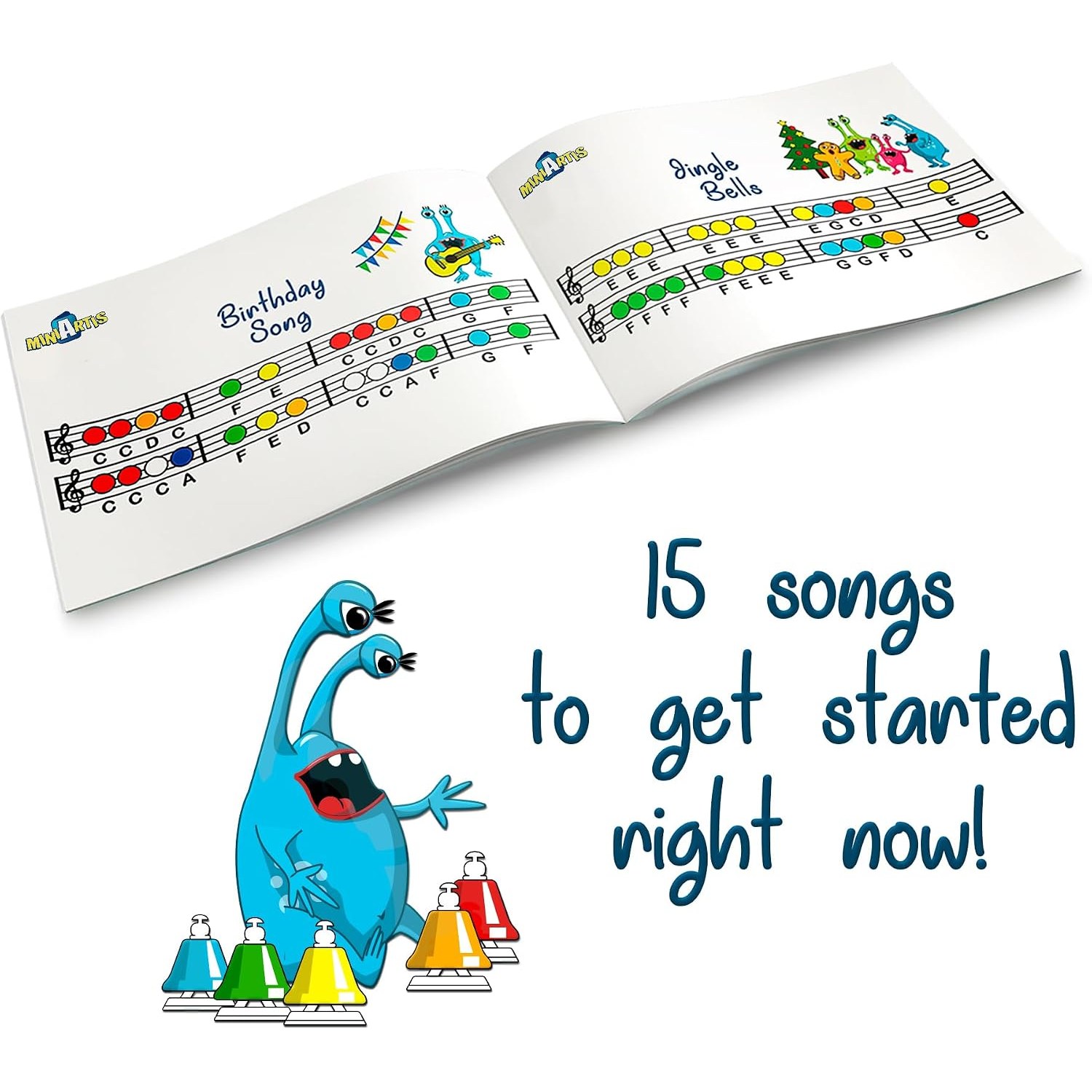
Each bell has its own colour. Colour coding sounds like a small detail and it is actually the feature that does the most work. Musical notation takes months to learn. Colour takes about four seconds. A child who can tell red from blue can follow a colour sequence and play a melody correctly, and while they are doing that their ear is learning what the intervals sound like. By the time notation arrives, the sounds are already familiar.
Who this suits
The manufacturer recommends ages three and up, and that is sensible. Around three, children have the hand control to press one specific bell on purpose rather than swiping the whole row. They also start to notice when a tune is wrong, which is the beginning of real listening.
It suits several groups beyond that age, though. Early years teachers use bell sets constantly because they solve a hard classroom problem, giving eight children a part each in the same piece. Homeschooling parents like them because the songbook provides structure without requiring the parent to play anything. Music therapists and carers use them with adults who find mallets or strings too fiddly, since pressing a plate needs very little force.
Older children are not too old for them either. A seven or eight year old will quickly move past the songbook and start working out tunes by ear, which is a genuinely useful skill and far harder to practise on an instrument that fights back.
What to look for when choosing a set
Start with tuning. A bell set that is not properly tuned is a rattle with pretensions. Tuned bells let a child hear when they have played the right note, and that feedback is half the learning. This set is tuned across a standard scale.
Then count the notes. Eight is the practical minimum for playing real songs, because it gives you a complete octave. Fewer than that and you keep hitting songs you cannot finish. Larger sets add sharps and flats, which matter for older students but mostly confuse beginners.
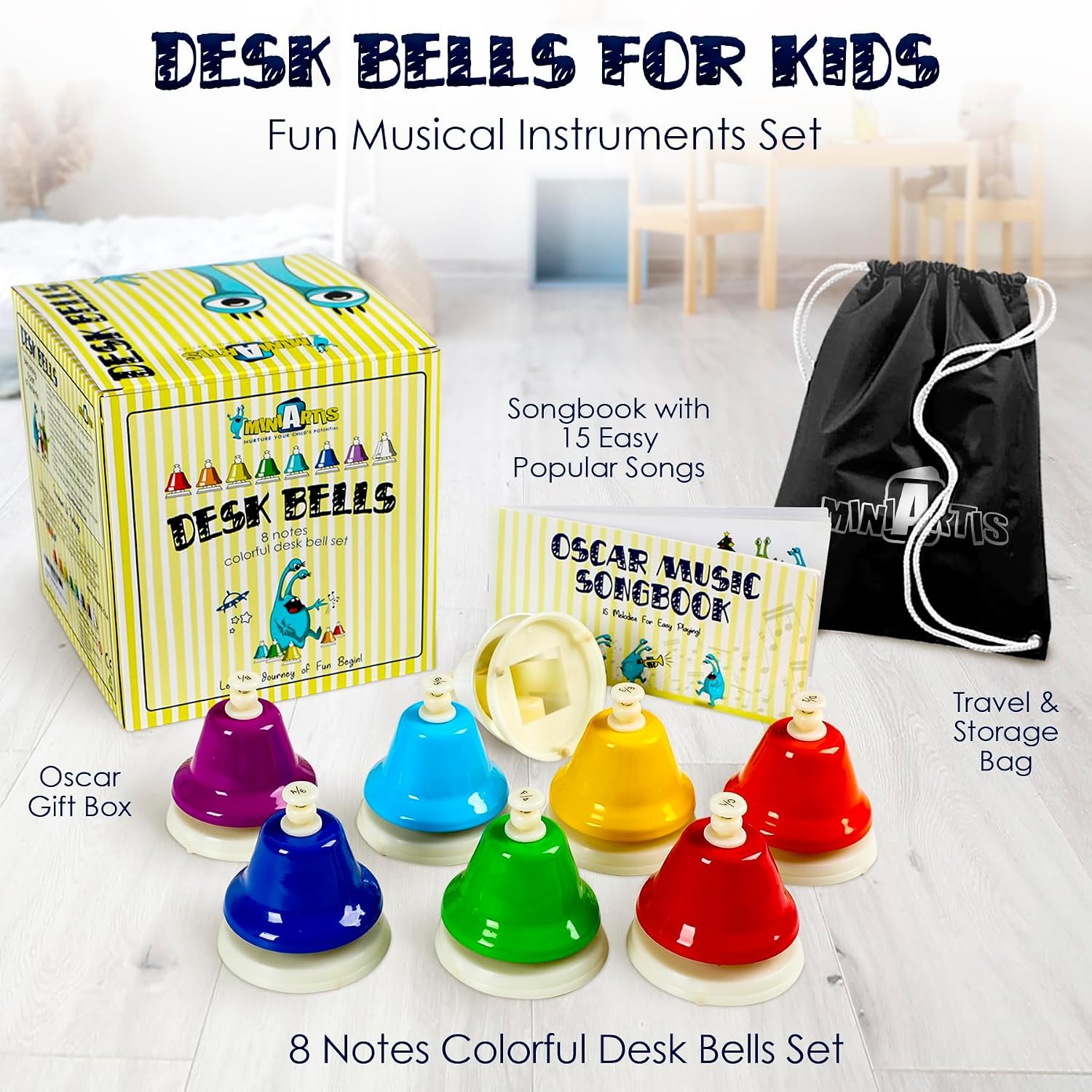
Check what comes with it. Bells on their own are a puzzle on day two. A songbook turns them into an activity. A bag turns them into something that can travel to a grandparent's house or a classroom without losing a note along the way. This set includes the songbook, the bag and a gift box, which is why it works as a present with no further preparation.
Look at the play action as well. Press-top bells are far easier for small hands than bells you have to shake, and they are quieter when a child is just exploring. Finally, consider size. At 8.9 x 8.9 x 10.2 cm per bell, eight of these sit comfortably along a table edge. The whole set is 1.04 kg, light enough to carry in one hand.
Getting started in the first week
Do not open the songbook immediately. Spend the first session letting the child press every bell and hear every note. Then play a game, you press a bell out of sight and they find the matching one by sound. That builds ear training without feeling like a lesson.
Next, line the bells up left to right in scale order, lowest to highest. Walking up and down the scale is satisfying in itself and it fixes the idea that pitch has a direction. After that, three-note songs work best. Hot Cross Buns uses three bells. Mary Had a Little Lamb uses four. Twinkle Twinkle uses six. Build up rather than starting with the hardest piece in the book.
If two or more children are playing, give each one a bell and call out colours in rhythm. They will get it wrong, laugh, and want to go again. That is the whole lesson and it teaches listening better than any worksheet.
Looking after them
Care is simple because there is almost nothing to go wrong. Wipe the bells with a soft cloth, dry or barely damp. Never put a bell under a running tap or in a dishwasher, since water inside the mechanism dulls the tone and may stop the clapper moving freely.
Keep them indoors. The listing specifies indoor use, and damp or sand will shorten the life of the striking parts. Store them in the supplied bag between sessions. That stops the colours scuffing and, more practically, stops a bell from vanishing behind a sofa, which is how most eight-note sets become seven-note sets.
If a bell sounds muffled, check the surface underneath. A thick rug or a cushion absorbs the ring and stops the plate from travelling properly. Move to a hard table and the tone usually returns at once.
The short version
Eight tuned bells, colour-coded, played with one tap. They cover a full C to C scale, which is enough for most songs a child will want to play. A songbook, a bag and a gift box come in the package, so it is ready to use or ready to give with nothing else needed.
No batteries, no assembly, nothing to tune or restring. For a child aged three and up who has never played anything, this is about as low as the barrier to making real music gets. And for a parent who is not musical, it is one of the few instruments you can hand over without needing to teach anything first.