
The complete guide
Choosing a Pink RC Stunt Car That Survives Real Kids
The problem with most first remote control cars
Ask any parent who has bought a cheap remote control car and you will hear the same story. The first ten minutes are brilliant. Then the car hits a wall, lands on its roof, and the whole thing grinds to a halt. An adult gets called over. The car gets flipped. Thirty seconds later it happens again.
The second story is about batteries. The car runs for a while, dies, and then sits on a shelf because the AA cells it needs are the same ones the TV remote just ate. By the time someone buys more, the novelty is gone.
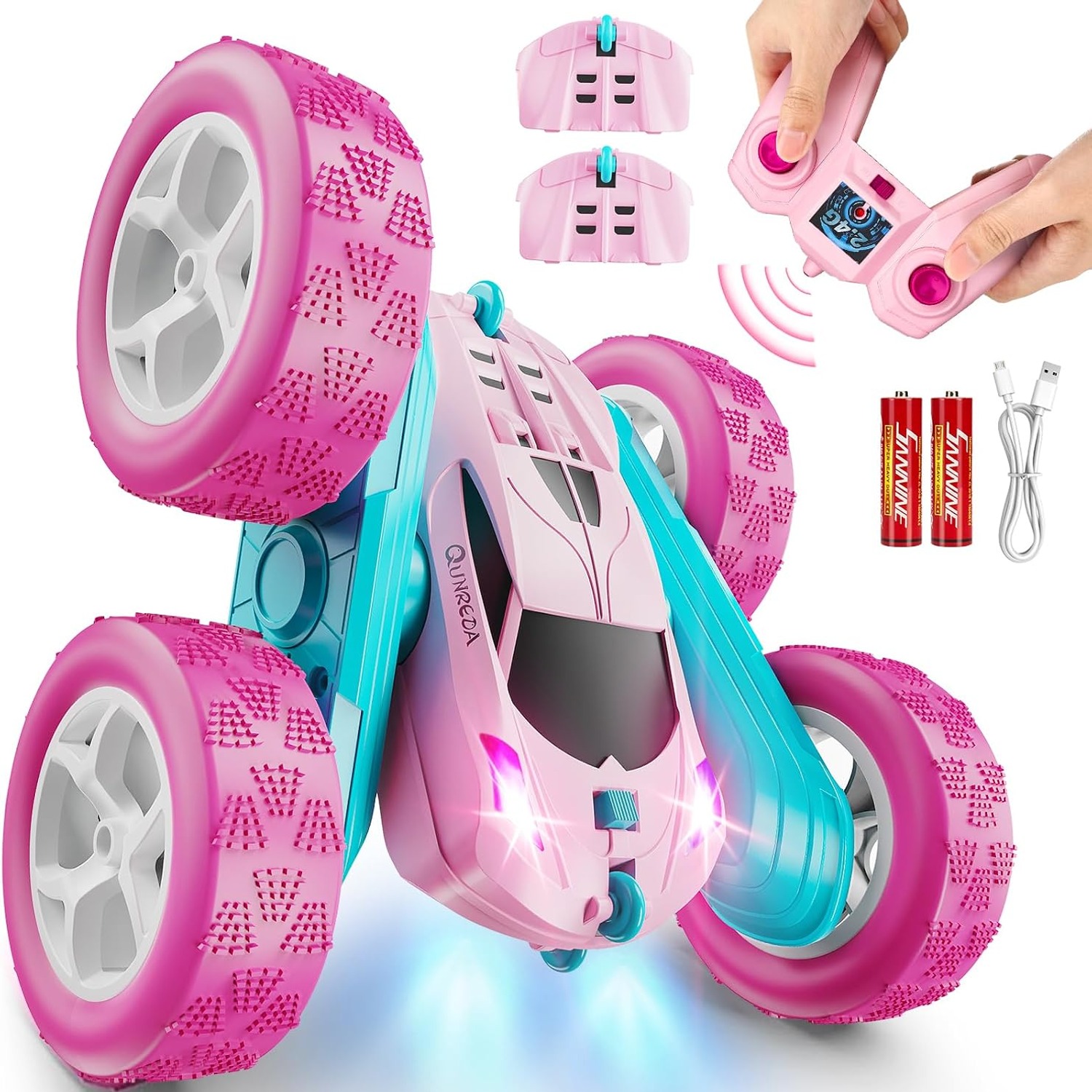
A pink RC stunt car with a double sided body and two swappable rechargeable packs fixes both of those problems at once. That is really the whole pitch, and it is a better pitch than most spec sheets in this category.
How a double sided stunt car works
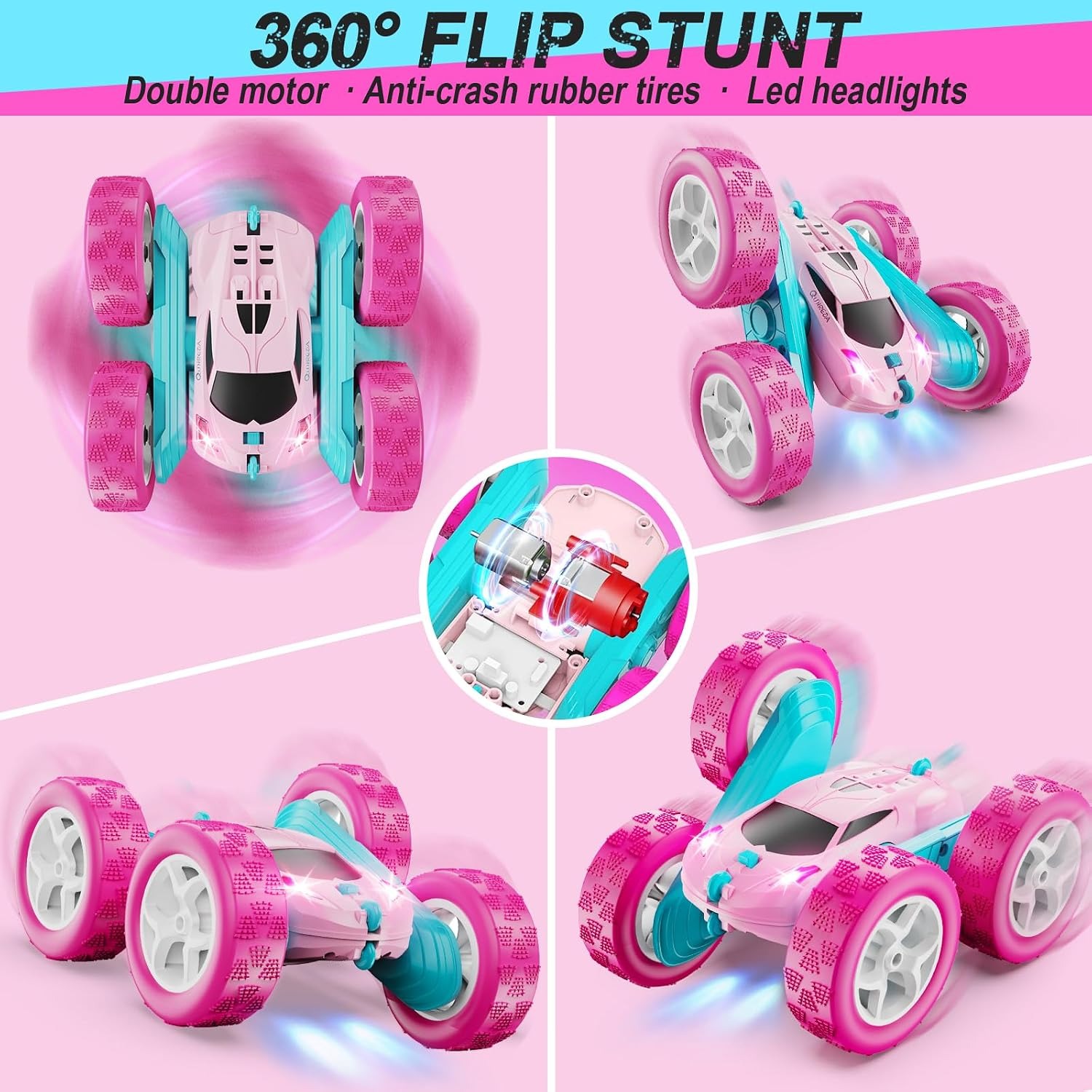
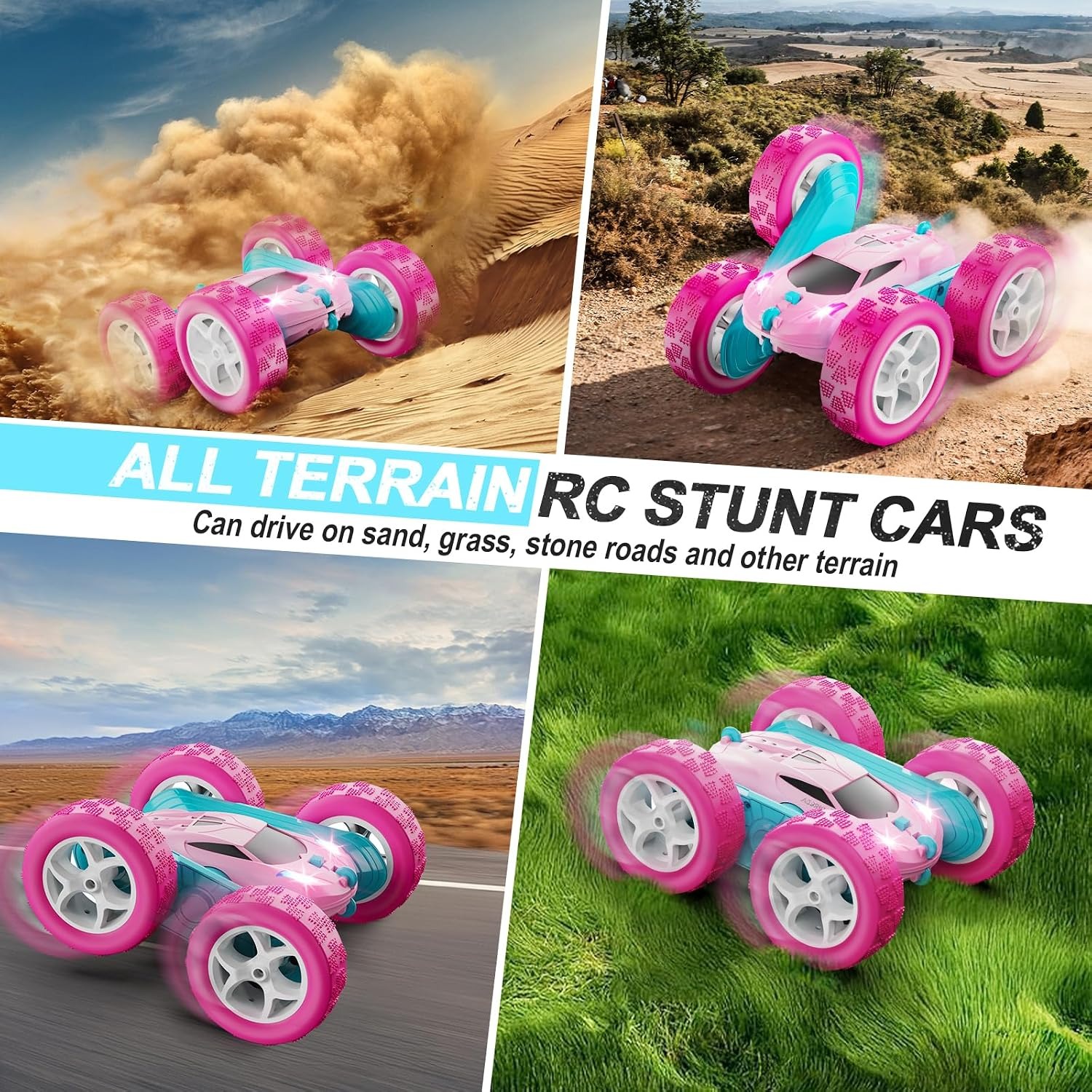
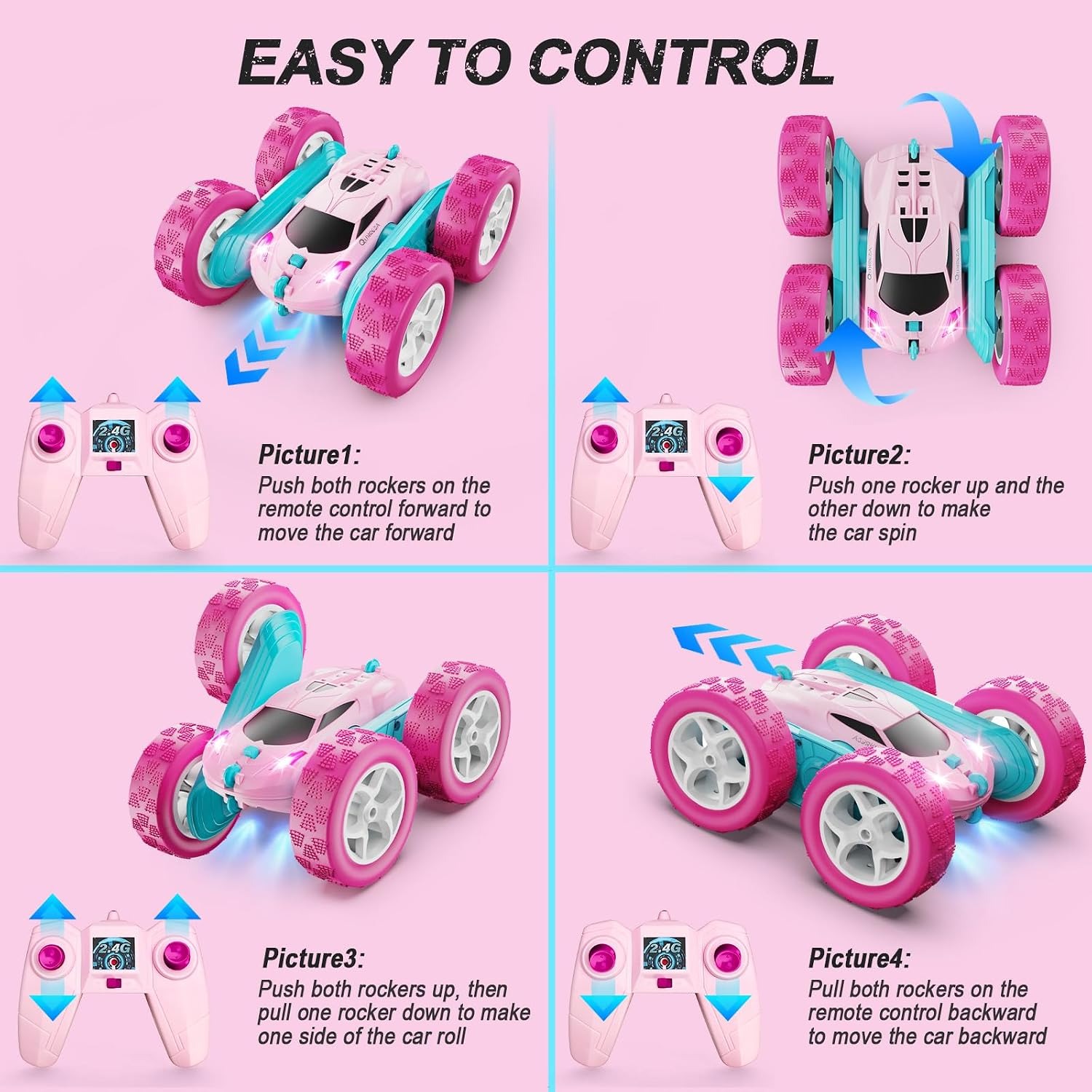
The idea is simple. Instead of having a proper top and a proper bottom, the car is built with a drivable face on each side. The wheels stick out far enough that whichever way up it lands, they still touch the ground and still turn.
So the child drives it into a chair leg, it tips over, and nothing happens. It keeps driving. Then they realise they can flip it on purpose, and that becomes the game. A lot of the best rc stunt car play is not racing at all, it is seeing how many times you can roll it along a hallway.
There is a knock-on benefit that is easy to miss. Because crashing has no penalty, kids drive more confidently and learn faster. They are not nervously creeping along trying to avoid an upset. They are throwing the car around and getting real feedback about how the controls behave.
This particular model is listed at a maximum speed of 10 km/h. That number sounds modest written down, but on a kitchen floor it is quick, and it is about right for a six year old. Faster toy cars look impressive in product videos and spend most of their life wedged under furniture.
What the battery setup really changes
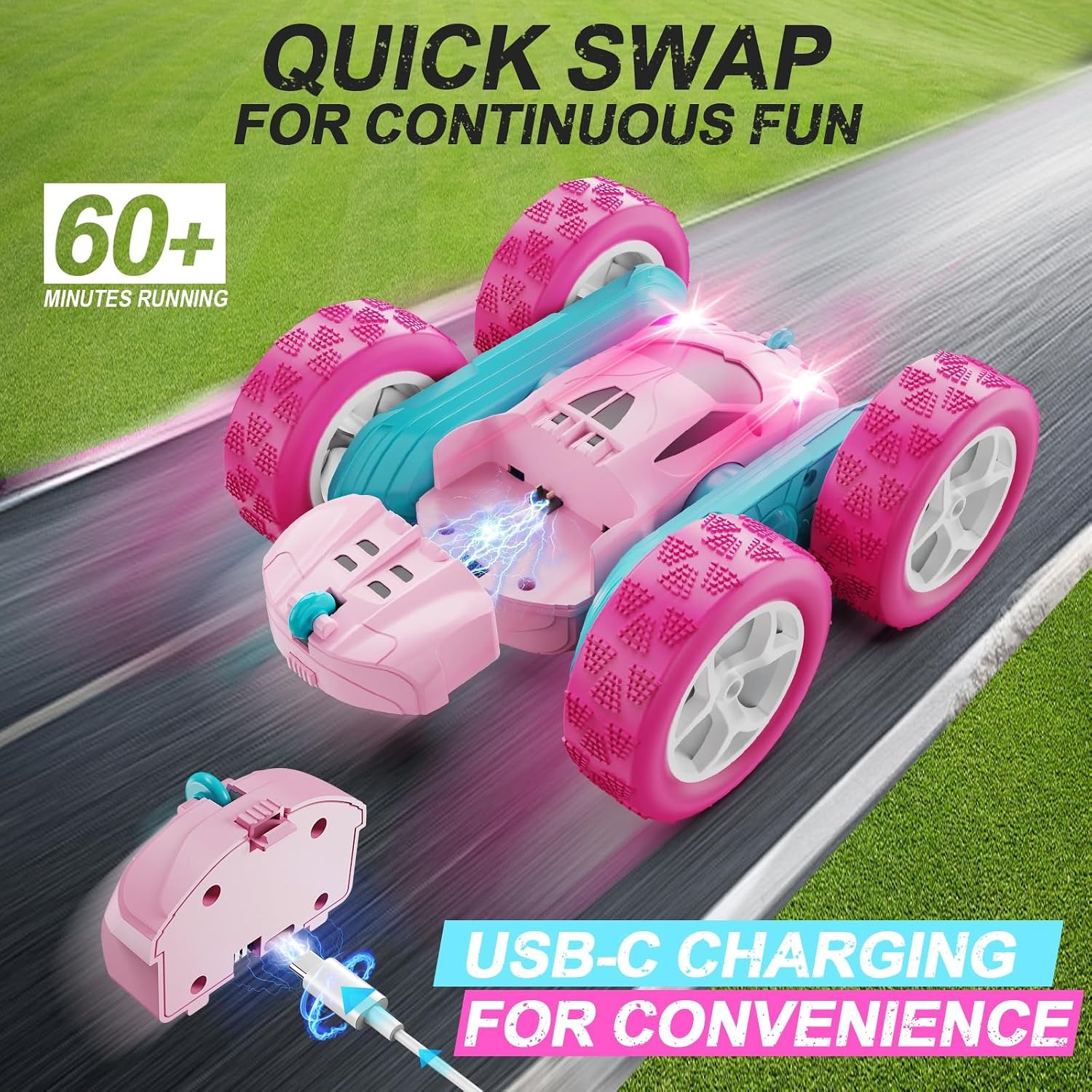
Two rechargeable 500 mAh lithium-ion packs come in the box. They are modular, which means each one is a self-contained unit that clicks into the car rather than a pair of loose cells you wrestle into a sprung compartment.
Here is why that matters in a real house. One pack is in the car, the other is on charge. When the car slows down, the child swaps packs themselves in a few seconds and carries on. The flat one goes on the cable. There is no trip to the shop and no screwdriver fumbling on the carpet.
Charging is over USB-C. That is the same connector used by most recent phones, tablets and handheld consoles, so there is usually a spare cable and a spare wall plug within reach. A cable is included anyway.
The handset runs on two AA batteries, which are also supplied, and the included screwdriver opens that compartment. It is the kind of detail that stops a gift from being half-usable on the day.
Run time and charge time are not listed by the maker, so we are not going to make numbers up. What we can say is that having a second pack in the box is worth more than any single quoted figure, because it doubles whatever the real number turns out to be.
Who this suits
The recommended age is 6. That is a sensible starting point rather than a hard rule. A six year old generally has the coordination to steer a moving object with two thumbs and the judgement to keep it off the road and away from the top of the stairs.
Younger children can absolutely enjoy it with an adult or older sibling driving while they chase it around, and plenty of five year olds pick up the controls fine. Older kids, eight and up, tend to invent obstacle courses and challenges rather than just driving in circles.
It suits indoor play particularly well. Hard floors, hallways, the gap under a dining table and the space between the sofa and the wall all become track. The LED lighting on the body helps here, because a lit car is easy to spot when it disappears into a shadow, and it makes evening play feel like a bit of an event.
Outdoors it is happiest on smooth surfaces. An open court, a paved area, a flat concrete path. Keep it off sand, deep gravel and anything wet. Those are the three things that will shorten the life of a small RC car faster than any number of crashes.
How to choose between stunt cars
If you are comparing a few options, a short checklist helps more than reading every bullet point.
Start with whether it actually drives upside down, or only claims to be a stunt car because it can spin on the spot. A genuine double sided rc car keeps moving after a flip. That is the feature doing the heavy lifting.
Then look at the power. Does it include rechargeable cells, or does it quietly expect you to supply a fistful of AAs? Does it include more than one? A car with a spare pack included is worth noticeably more than the price difference suggests.
Check the size against where it will be used. At 16 x 16 x 7.1 cm this one is compact, which is good for indoor spaces and easy for a child to carry. Much larger cars need more room to be fun.
Look at the material. ABS is the standard here for good reason. It takes impacts and flexes rather than cracking. For a toy whose entire purpose is hitting things, that matters.
Finally, think about assembly and setup. This one arrives built, with batteries, and a cable. On a birthday morning that is the difference between playing now and playing after a trip to the shop.
Looking after it
None of this is complicated, but a few habits will add months to the car's life.
Wipe the shell with a dry or lightly damp cloth. Do not run it under a tap. Water and small electronics have never got along.
After play on carpet or anywhere with pets, check the wheels and axles. Hair and fluff wrap around the axles and slowly strangle the motor. A minute with your fingers or a pair of tweezers keeps it running like new. This is genuinely the most common cause of a toy car "going slow" for no reason.
Charge the packs somewhere you can see them, on a hard surface, and unplug once they are done. If the car is going away in a cupboard for a few weeks, take the packs out of the car and the AA cells out of the handset. Batteries left in unused toys are the number one cause of corroded contacts.
Keep both the car and the handset out of direct sun and away from damp. Normal room temperature storage is all it asks.
The short version
This is a pink remote control stunt car that solves the two things that usually ruin a first RC car. It drives upside down, so crashes do not end the game. It comes with two rechargeable battery packs that swap in seconds and charge over USB-C, so flat batteries do not end the game either.
The spec list is straightforward. ABS body, 16 x 16 x 7.1 cm, half a kilo, 10 km/h top speed, LED lighting, recommended from age 6, no assembly needed. Handset AAs, a charging cable and a screwdriver are all in the box.
If you want a toy that gets picked up again next week instead of sitting on a shelf, the combination of forgiving design and spare power is what gets you there.