Toy Warehouse
Company
Shop By Category
T&Cs
Shop Online
  • Box contents listed
  • Free tracked delivery across Singapore over $150
  • 14-day returns

Electric Circuit Motor Kit | Kids circuit kit | Science experiment kit

Electric Circuit Motor Kit for Kids

$53.99 $64.99 Save $11
  • Build Real Circuits
  • No Soldering Needed
  • Motors And Propellers
  • Ready For Projects

Price: $53.99 $64.99

  • Free tracked delivery across Singapore on orders $150+, otherwise a flat $20
  • Pay by card or PayPal, handled by the payment provider
  • 14 days to change your mind, plus your statutory rights
Product specifications
BrandSntieecr
Model NumberST-0241
Manufacturer Part NumberST-0241
Recommended Age8 years and up
Age Range DescriptionKid
Educational ObjectiveSTEM
ThemeScience
MaterialPlastic, Metal
Battery DescriptionAlkaline
Assembly RequiredNo
SizeSmall
Item Dimensions12 x 10 x 3 cm
Shipping & returns

Tracked delivery anywhere in Singapore. It is free on orders of $150 or more, and a flat $20 below that.

If it is not right for you, send it back within 14 days of delivery in resaleable condition and we refund the price you paid, including standard delivery. That is a voluntary policy we offer on top of your legal rights. You cover the cost of returning it unless the item is faulty.

If it arrives faulty, damaged or not as described, we put it right at no cost to you, return postage included, and your protection under the Consumer Protection (Fair Trading) Act 2003 is unaffected.

Shipping details · Refunds and returns

Build Real CircuitsBulbs, buzzers and motors wire up into working loops children can see and hear.
No Soldering NeededCrocodile clip leads snap onto terminals, so nothing is permanent and mistakes are easy to fix.
Motors And PropellersTwo motors with holders and six propellers turn electricity into visible movement.
Ready For ProjectsSuits school science assignments, homeschool lessons and curious kids at home.

Turn a kitchen table into a workbench with an electric circuit motor kit that makes bulbs glow, buzzers sound and propellers spin.

Crocodile clip leads, motors, switches, bulbs and propellers arrive ready to connect, so children aged 8 and up can build working circuits in minutes and change them just as fast.

This electric circuit motor kit gives children the parts they need to build simple working circuits from scratch.

Crocodile clip leads connect bulbs, buzzers, switches and motors without solder, glue or tools.

Two DC motors with holders and six propellers (three with three vanes, three with four vanes) show electricity turning into motion.

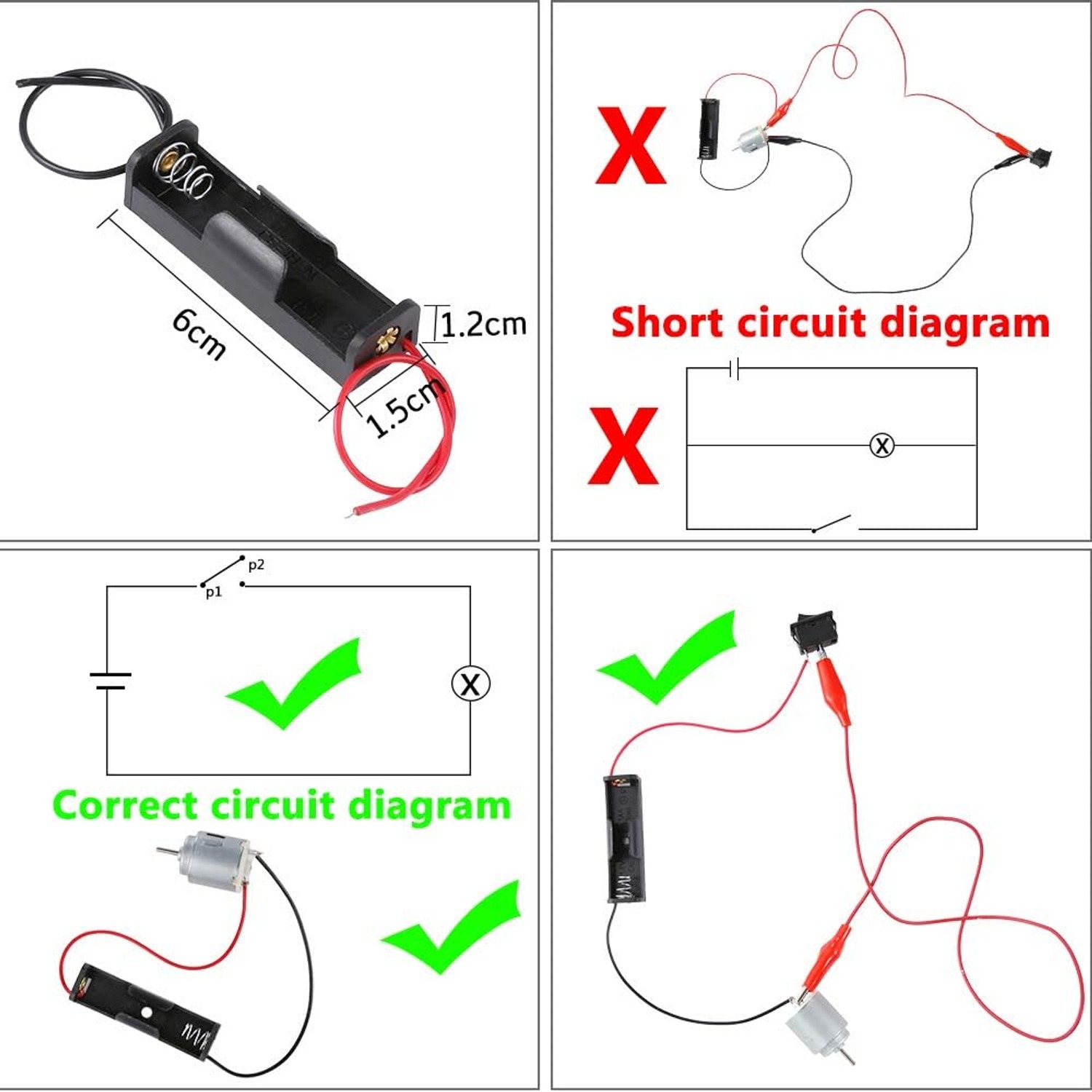
Battery holders for one AA and two AA cells let kids compare what happens when voltage changes.

Recommended for ages 8 and up, with no assembly required before the first experiment begins.

Electric Circuit Motor Kit for Kids

Electricity is hard to picture because you cannot see it. A kit like this fixes that problem by giving the current something to do at the end of the wire. A bulb lights, a buzzer sounds, a motor spins a propeller fast enough to feel the air move. Children stop memorising a diagram and start watching cause and effect happen in front of them.

Electric Circuit Motor Kit for Kids

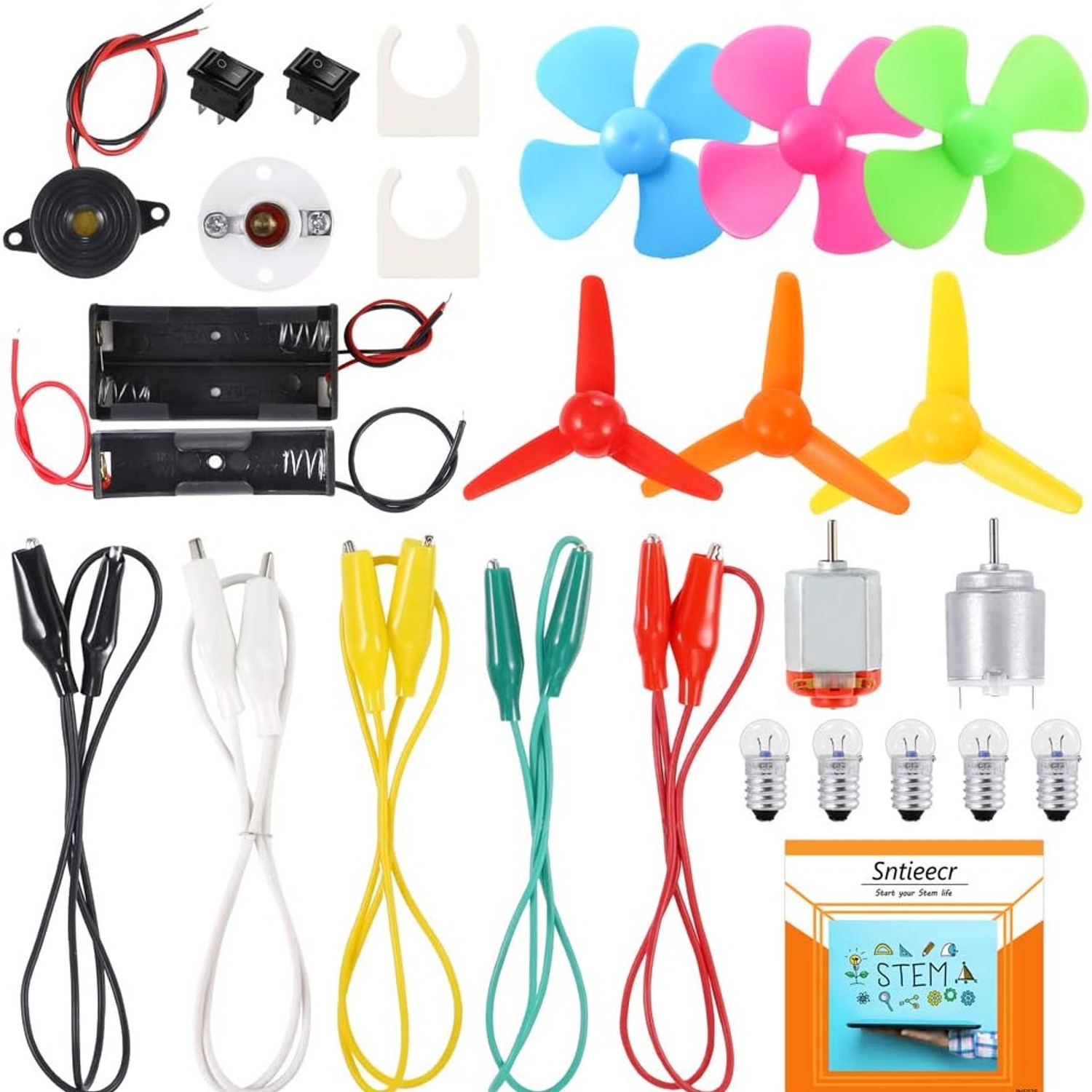
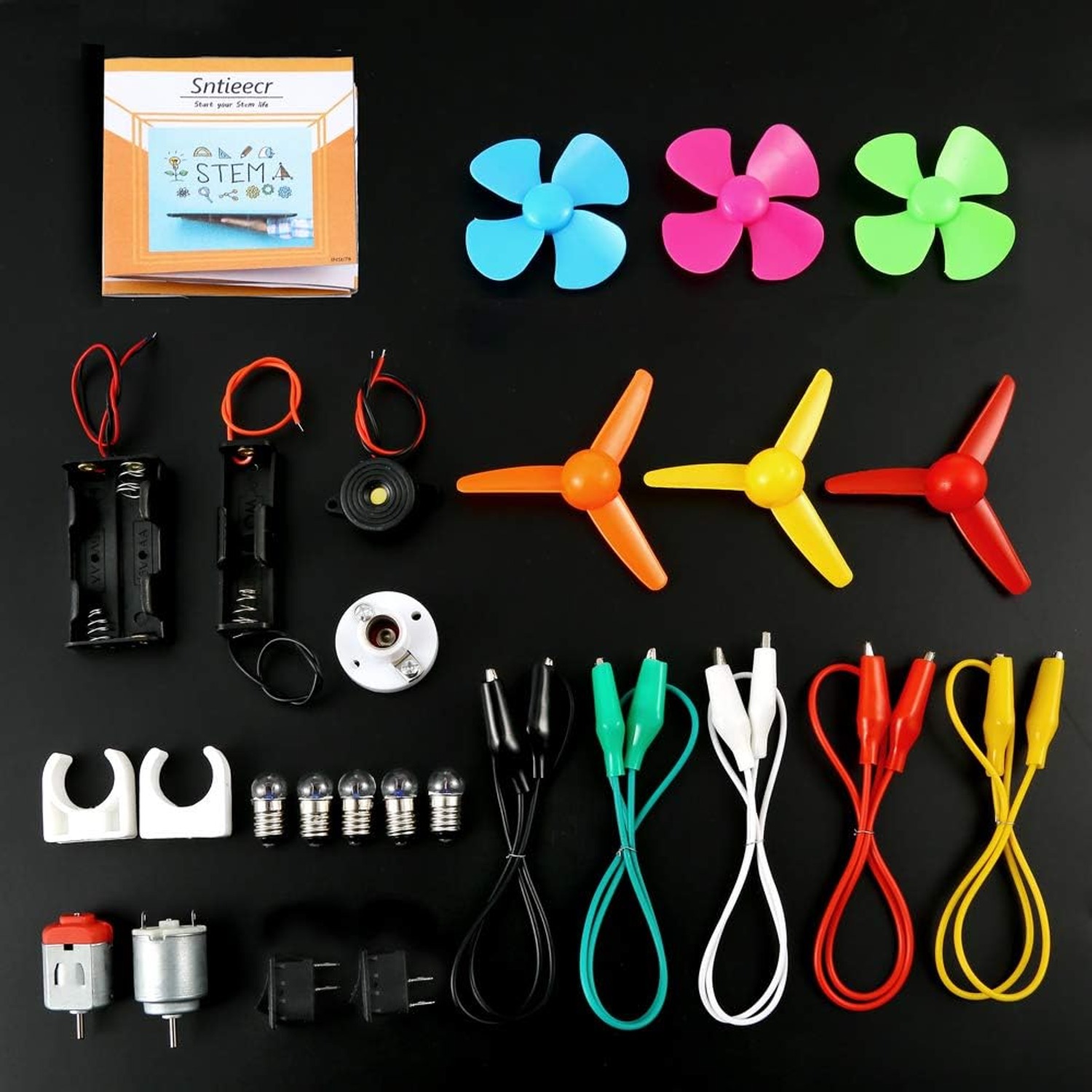
The parts list is built for experimenting rather than following one fixed build. There are five crocodile clip leads, five bulbs and a bulb holder, two motors with two motor holders, two rocker switches, one buzzer, three propellers with three vanes and three with four vanes, plus battery holders for a single 1.5V AA cell and for two AA cells. An instruction sheet is included to get the first circuit working.

Electric Circuit Motor Kit for Kids

Because every connection is a crocodile clip, nothing is permanent. A child can build a circuit, break it, swap the bulb for the buzzer, add the switch, then start again. That loop of trying and changing is where the learning sits. It also means a wrong guess costs nothing but a few seconds, which keeps confidence up.

Electric Circuit Motor Kit for Kids

The two battery holders are quietly the most interesting part. One AA cell gives 1.5V. Two give 3V. Running the same motor or bulb on each shows what more voltage does without any maths at all, and it opens the door to questions about series connections, brightness and speed.

Electric Circuit Motor Kit for Kids

Recommended for ages 8 and up, no assembly is required before the first session. Materials are plastic and metal. The kit measures 12 x 10 x 3 cm, so it stores easily on a shelf or in a school bag for a classroom project day.

Not sure yet? That is fine.

A toy has to suit the child it is for, and you cannot always judge that from a photograph. If it is not right for you, send it back within 14 days of delivery in resaleable condition and we refund the price you paid, including standard delivery. That is a voluntary policy we offer on top of your legal rights.

If it turns up faulty, damaged or not as described, that is on us. We pay the return postage, with your protection under the Consumer Protection (Fair Trading) Act 2003 unaffected. Read the full detail on our refunds and returns page, or ask us anything before you order.

Frequently Asked Questions

What is an electric circuit motor kit?

It is a set of electrical components that children connect together to make a working circuit. This one includes bulbs, motors, propellers, switches, a buzzer, battery holders and crocodile clip leads. The point is to see electricity do something you can watch or hear.

What age is this kit for?

The manufacturer recommends 8 years and up. Younger children can take part with an adult doing the fiddly clipping. Older children and teens tend to use it for school science projects rather than free play.

What exactly comes in the box?

An instruction sheet, 5 crocodile clip leads, 5 bulbs, 1 bulb holder, 2 motors, 2 motor holders, 2 rocker switches, 1 buzzer sounder, 3 propellers with three vanes, 3 propellers with four vanes, an AA battery holder for one 1.5V cell and an AA holder for two cells. That is what the maker lists for this model.

Are batteries included?

The maker does not specify whether batteries are supplied. The kit uses alkaline AA cells in the included holders. It is safest to have a few fresh AA batteries on hand before the first session.

Does anything need to be assembled first?

No. The maker lists assembly required as "No", so the components arrive ready to connect. The building happens as part of the activity, not before it.

Is soldering required?

No soldering is needed. Every connection is made with a crocodile clip lead that bites onto a terminal. That is one reason this works as a best beginner electronics kit for a child who has never built anything electrical.

How long does the first circuit take to build?

Most children get a bulb lit within a few minutes once they understand that current needs a complete loop. Adding a switch or a motor takes another minute or two. The time goes into experimenting afterwards, not into setup.

What can my child actually build with it?

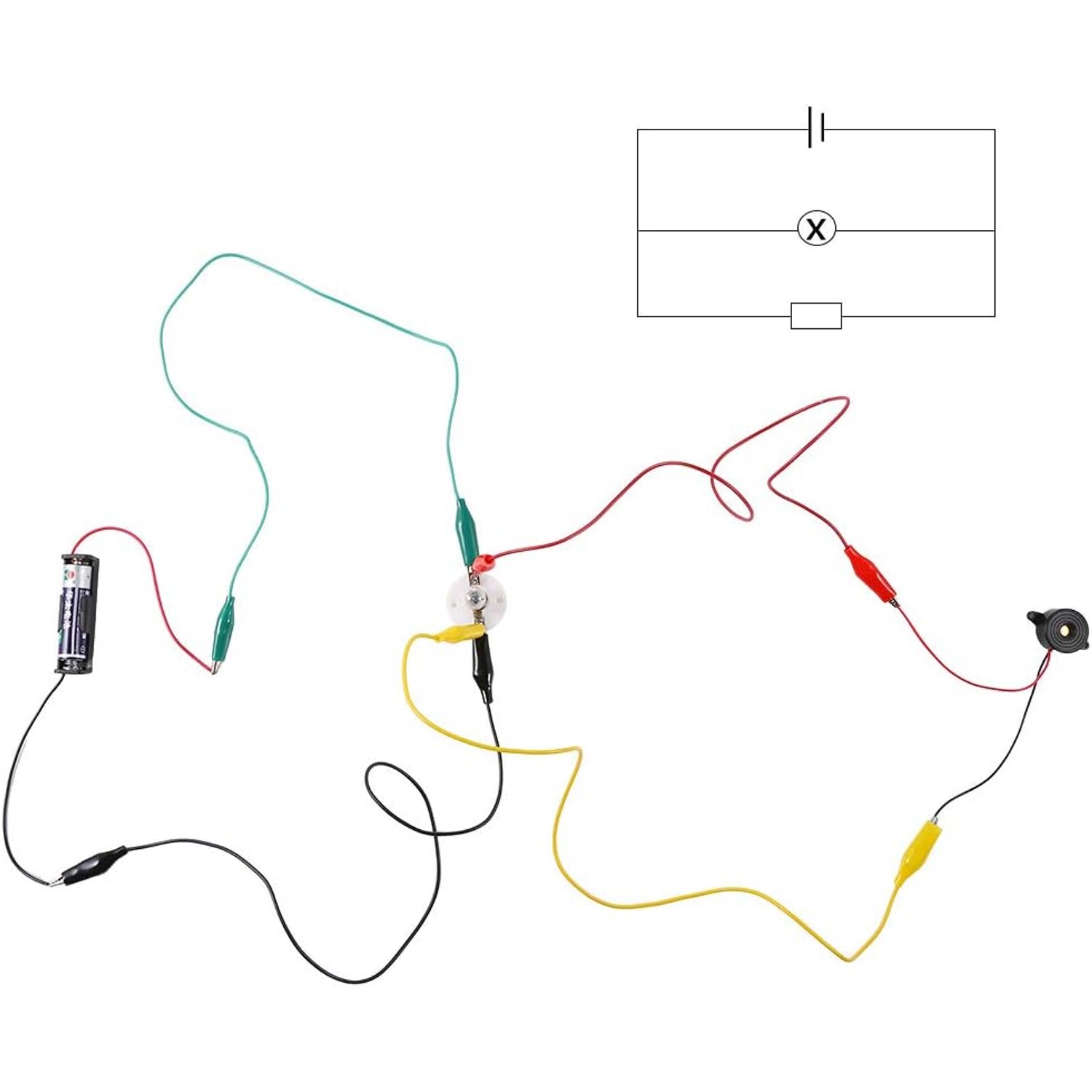
A simple lit bulb circuit, a switched bulb circuit, a buzzer alarm, a spinning motor with a propeller, and combinations of those. Swapping the one-cell holder for the two-cell holder changes brightness and motor speed. The instruction sheet gives a starting point and the rest is open-ended.

What are the propellers for?

They push onto the motor shafts so the spinning becomes visible and you can feel the airflow. Three have three vanes and three have four vanes, which lets children compare how blade count affects the push. It makes a best propeller motor kit style activity easy to set up.

Why are there two different battery holders?

One holder takes a single 1.5V AA cell and the other takes two cells for 3V. Running the same bulb or motor on each shows what extra voltage does to brightness and speed. It is a simple way to teach the idea without any formulas.

Can this be used for a school science project?

Yes, it is a common choice for one. A child can demonstrate a complete circuit, the role of a switch, and how voltage changes motor speed, all with parts the class can see. It works well as a best school science project kit because everything is reusable.

Is it suitable for homeschooling?

It suits homeschool lessons well because it covers several topics with one box. You can run a short session on circuits one week and motors the next. Many families use it as a best homeschool science kit for the primary and lower secondary years.

Is this a Montessori style toy?

It fits the hands-on, self-directed spirit of that approach because the child leads the experimenting. There is no score, no app and no single correct outcome. The feedback comes from whether the bulb lights or not.

What materials are the parts made from?

The maker lists plastic and metal. The leads, clips and motor parts use metal for conductivity, and the holders and propellers are plastic. The maker does not state other material detail.

What colour is the kit?

Colour is not specified in the maker's details. Component colours in kits like this usually vary by part rather than following one scheme. Treat the photos as a guide.

How big is it?

The listed item dimensions are 12 x 10 x 3 cm. That is small enough to sit in a drawer or go into a school bag. Package weight is not specified by the maker.

Where is it made?

Country of origin is not specified in the maker's details. The brand listed is Sntieecr and the model number is ST-0241.

Does it need adult supervision?

Supervision is sensible, especially for the first few sessions and with children at the younger end of the range. The parts are small and the clips have teeth. Nothing in the kit runs on mains power, so the risk stays low.

Is it suitable for a child to handle the batteries?

AA cells at 1.5V are low voltage and the holders are made to keep contact simple. Still, an adult should check that cells go in the right way round and that no battery is left in a hot or damp place. Remove the batteries when the kit is packed away.

Can two children share one kit?

Yes, and it often works better that way. With five leads and several components, two children can build separate small circuits or work on one larger one together. It is a good best hands on learning toy for siblings close in age.

What happens if a bulb stops lighting?

Check the clips first, since a loose bite on a terminal is the usual cause. Then check the battery and try one of the spare bulbs. Having five bulbs in the kit means a blown one does not end the session.

Will the motors wear out?

Small DC motors last a long time with light use, but they are not laboratory grade. Avoid running a motor while holding the shaft still, as that strains it. Two motors are included so one spare is always on hand.

How should I store the kit?

Keep the parts in the original box or a lidded container so clips and propellers do not get lost. Take the batteries out of the holders first. A dry shelf away from heat is ideal.

How do I clean the parts?

Wipe plastic parts with a slightly damp cloth and dry them properly. Do not run water over the motors, buzzer or battery holders. Dust on contacts can be brushed off gently with a dry cloth.

Does it connect to a phone or app?

No, it is entirely physical. Nothing pairs, downloads or updates. For many parents looking for a best STEM toy for 8 year olds, that is the appeal.

Is it a good gift?

It makes a solid gift for a child who asks how things work or who likes taking things apart. It is also a practical present before a science unit at school. Consider adding a pack of AA batteries so it can be used the same day.

Can older teenagers get anything from it?

A teenager will move past the basics quickly, but the kit still works as a demonstration tool for series circuits, switching and motor load. It is better suited to the 8 to 13 range for discovery learning. Beyond that it becomes a prop rather than a puzzle.

Will it teach circuit theory properly?

It teaches the ideas that matter early, like complete loops, switching, voltage and load. It does not include a multimeter, resistors or a breadboard, so it is not a formal electronics course. Think of it as the step before that.

How long will delivery take?

We deliver to addresses across Singapore with a tracked courier. Most orders arrive within 7 to 12 working days of the order date, because our toys are sent from overseas warehouses. Delivery is free on orders of $150 or more and a flat $20 under that.

What if the kit is not right for my child?

Get in touch and we will sort it out. If a component is missing or faulty, tell us which part and we will arrange a replacement or a return under our returns policy. Keep the box and packaging until you are happy the kit is right.

How to Choose an Electric Circuit Motor Kit for Kids

6 min read Toy Warehouse

The problem with teaching electricity

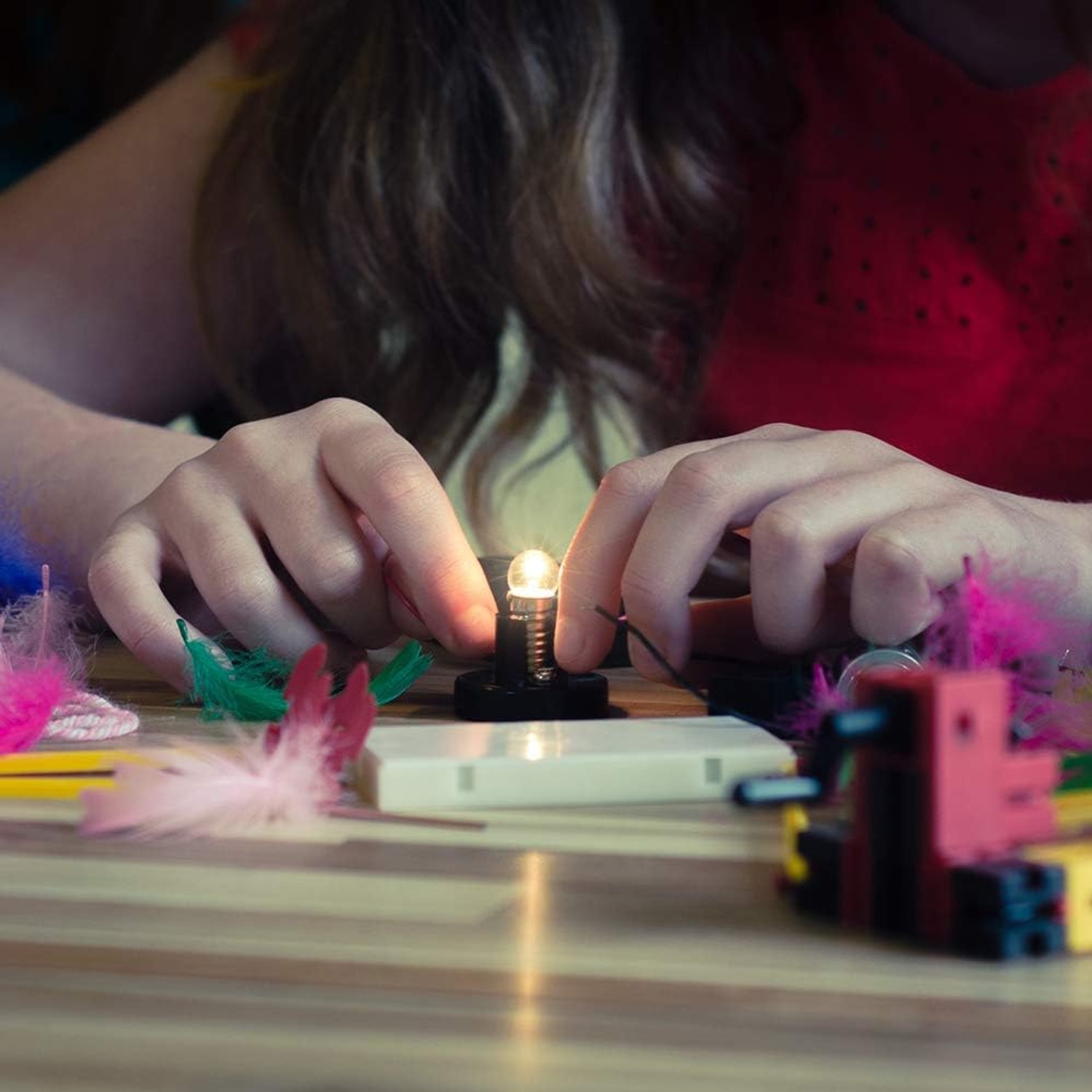
Electricity is invisible. You can draw a circuit on paper, label the battery and the bulb, and a child will nod along without really believing any of it. Diagrams do not convince anyone. A bulb that lights when you close a switch, and goes dark when you open it, convinces everyone immediately.

That gap between the diagram and the real thing is what a circuit kit closes. The child is not reading about current. They are holding two ends of a lead and finding out that one arrangement works and another does nothing at all. The failure is as useful as the success, because they have to look at the loop and work out where it is broken.

This kit takes that idea and adds movement. A bulb glowing is good. A propeller spinning hard enough to push air at your face is better, because now electricity has turned into something physical you can feel.

What is actually in the box

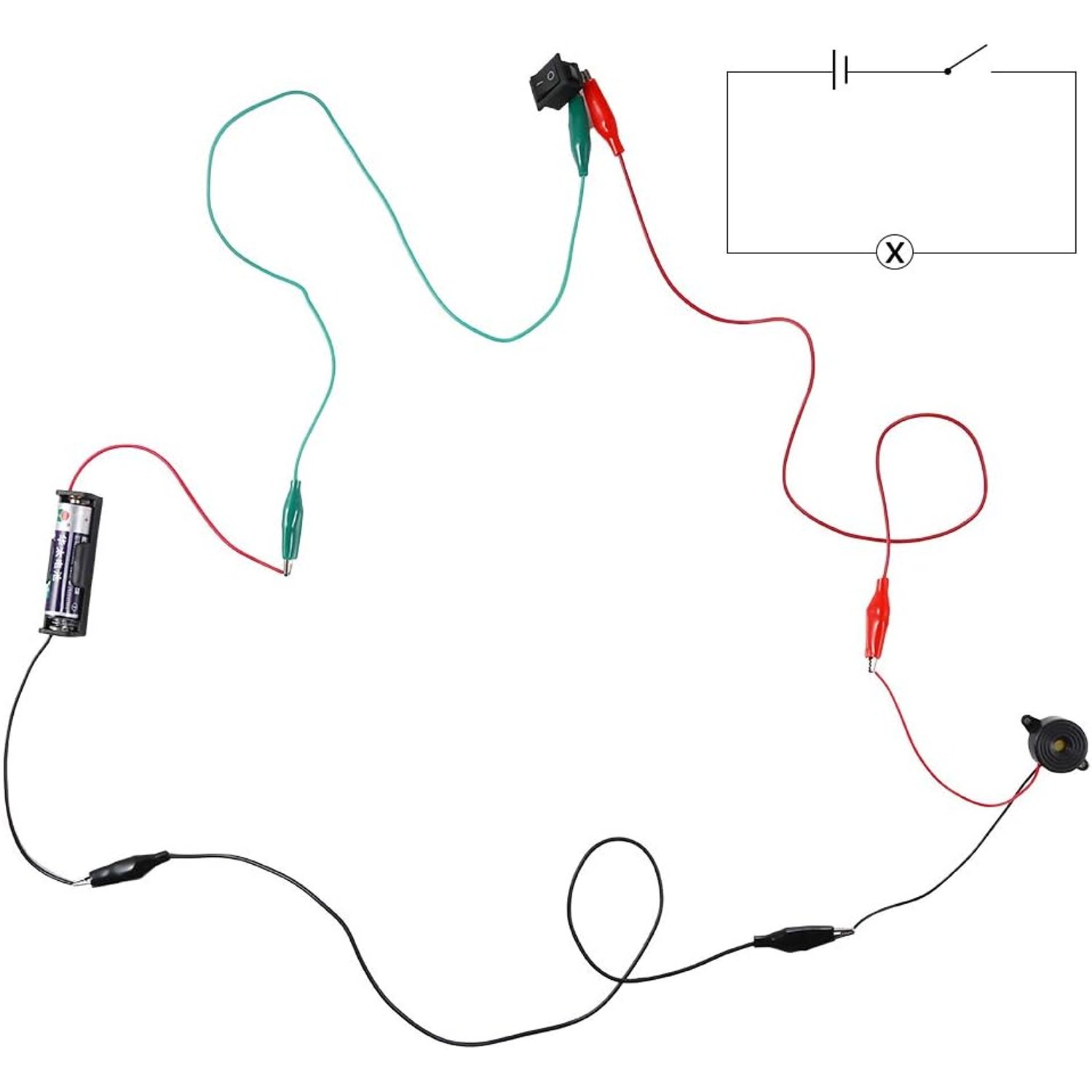
The parts list is deliberately broad rather than deep. You get five crocodile clip leads, five bulbs and a bulb holder, two DC motors with two motor holders, two rocker switches, a buzzer, three propellers with three vanes, three propellers with four vanes, and two battery holders. One holder takes a single 1.5V AA cell. The other takes two.

An instruction sheet comes with it. That sheet gets the first circuit working, which matters, because the hardest moment in any new kit is the one before anything happens. After that the parts take over.

Nothing needs assembling before you start. Open the box, pop the batteries in the holder, clip a lead from the holder to the bulb holder, clip another lead back, and you have a circuit. The whole thing is small, 12 x 10 x 3 cm, so it does not take over a room.

How it works in practice

Every connection is a crocodile clip. The clip has a spring and teeth, and it bites onto a metal terminal. There is no soldering, no screwing, no stripping of wire ends.

That design choice does more than keep things safe. It makes the kit forgiving. A child who builds a circuit wrong can pull one clip off, move it, and try again in two seconds. Nothing is wasted and nothing is ruined. When mistakes are cheap, children make more of them, and making more of them is how they learn faster.

The two battery holders deserve attention. Swap the one-cell holder for the two-cell holder and the same bulb gets brighter, the same motor spins faster, the same buzzer gets louder. No one has to explain voltage first. The child notices the difference and asks why, which is a far better order to do it in.

Who it suits

The recommended age is 8 and up. In practice, eight to about twelve is the sweet spot. That is the age where children have the finger control to work the clips, the patience to retry a failed circuit, and enough curiosity to keep asking what happens if.

Below eight, an adult can do the clipping while the child chooses what to connect. The spinning propeller still does its job on a five year old. Just expect to be the hands.

Above twelve, the basics will be quick, but the kit still earns its place. Teenagers use it to demonstrate principles for a class, test ideas before building something more complex, or build a quick working model for an assignment. It is one of the better options for a best classroom electricity kit because everything is reusable and nothing gets consumed.

It also suits families who want a screen-free activity that still feels modern. There is no app, no pairing and no account to make. That alone is a reason many parents go looking for a best beginner electronics kit in the first place.

How to choose between kits like this

A few things actually matter when you compare circuit kits.

Count the leads. Five crocodile clip leads is enough for two or three simple circuits running at once. Kits with two or three leads limit you to one build at a time, which gets frustrating when two children are sharing.

Look at the spares. Five bulbs means a blown bulb does not stop the afternoon. Two motors means the same for motors. Kits with one of everything are fine until something fails, and then they are finished.

Check whether there is more than one battery option. A kit with a single fixed holder can only show one voltage. Two holders turns a toy into an experiment, because now there is a variable to change.

Think about what the output does. Bulbs, buzzers and motors each appeal to different children. Some want light, some want sound, and plenty want the thing that moves. Having all three in one box means you are not betting on which type your child turns out to be.

Finally, be honest about the level. This is a discovery kit, not an electronics course. There is no multimeter, no breadboard, no resistors to calculate with. If your child is already building on a breadboard, they have outgrown this. If they have never made a bulb light, this is exactly the right starting point and probably the best STEM toy for 8 year olds in that position.

Getting the most out of it

Start with one bulb and nothing else. Let the child find the complete loop on their own, even if it takes a few goes. Resist fixing it for them.

Add the rocker switch next, because a switch makes the loop idea obvious. Open it and the light dies. Close it and the light returns. That single moment explains more than a page of text.

Then move to the motor and propellers. Try the three-vane propeller, then the four-vane one, and ask which pushes more air. Swap the battery holders and ask the same question again. These comparisons are the backbone of any best science experiment kit session, and they cost nothing but a few minutes.

Keep a notebook nearby if the child is doing this for school. Writing down what was connected and what happened turns an afternoon of play into something they can present. For a best school science project kit, the record matters as much as the build.

Care and storage

Take the batteries out when you are done. Cells left in a holder for months can leak and ruin the contacts, which is the single most common way kits like this die.

Keep everything in the original box or a container with a lid. Propellers and clips are small and they vanish under sofas. One container, one home, and the kit survives years instead of months.

Wipe plastic parts with a barely damp cloth if they get grubby, and dry them fully. Do not put the motors, buzzer or battery holders anywhere near water. Dust on a metal contact can usually be cleared with a dry cloth, which fixes more flaky connections than people expect.

Store it somewhere dry and out of direct heat. A shelf or a drawer is plenty.

The short version

This is a hands-on introduction to electricity for children aged 8 and up, built around crocodile clips so nothing is permanent and nothing needs tools. The box holds five leads, five bulbs, two motors, six propellers, two switches, a buzzer, a bulb holder and two battery holders, which is enough variety for several sessions rather than one.

It works best as a first real electronics experience, at home or for a school project. It does not pretend to be a full electronics course, and it does not need to be. It just needs to get a bulb lit and a propeller spinning, and then let the questions start.

Browse the shop

Ready to light the first bulb?

Order the kit today and add a pack of AA batteries so your child can start building the moment the box opens.

Ask us a question

Page summary

The Sntieecr Electric Circuit Motor Kit (model ST-0241) is a STEM science experiment set for children aged 8 and up. It includes an instruction sheet, five crocodile clip leads, five bulbs, one bulb holder, two DC motors, two motor holders, two rocker switches, one buzzer, three three-vane propellers, three four-vane propellers, a single AA (1.5V) battery holder and a two-AA battery holder. Batteries are alkaline type. Parts are plastic and metal, no assembly is required, and connections are made with clips rather than solder. The item measures 12 x 10 x 3 cm. Colour, country of origin, package weight and battery inclusion are not specified by the maker.