
The complete guide
How to Choose a Remote Control Unicorn Car That Actually Gets Played With
The toy that gets abandoned by Tuesday
Every family has one. A remote control car that looked great in the box, got twenty minutes of attention, then went under the bed and stayed there. It usually fails for the same handful of reasons. It flips and cannot right itself, so a child has to keep running over to flip it back. It needs six AA batteries that go flat in a week. Or the controls are fussy enough that the child gives up and asks an adult to drive it instead.
A stunt style car like this one tackles those problems directly. Rolling over is not a failure state, it is part of the act. The battery recharges from a USB cable rather than a shopping list of disposables. And the control set is deliberately small, which sounds like a limitation until you watch a four year old use it without being taught.
How a stunt RC car actually works
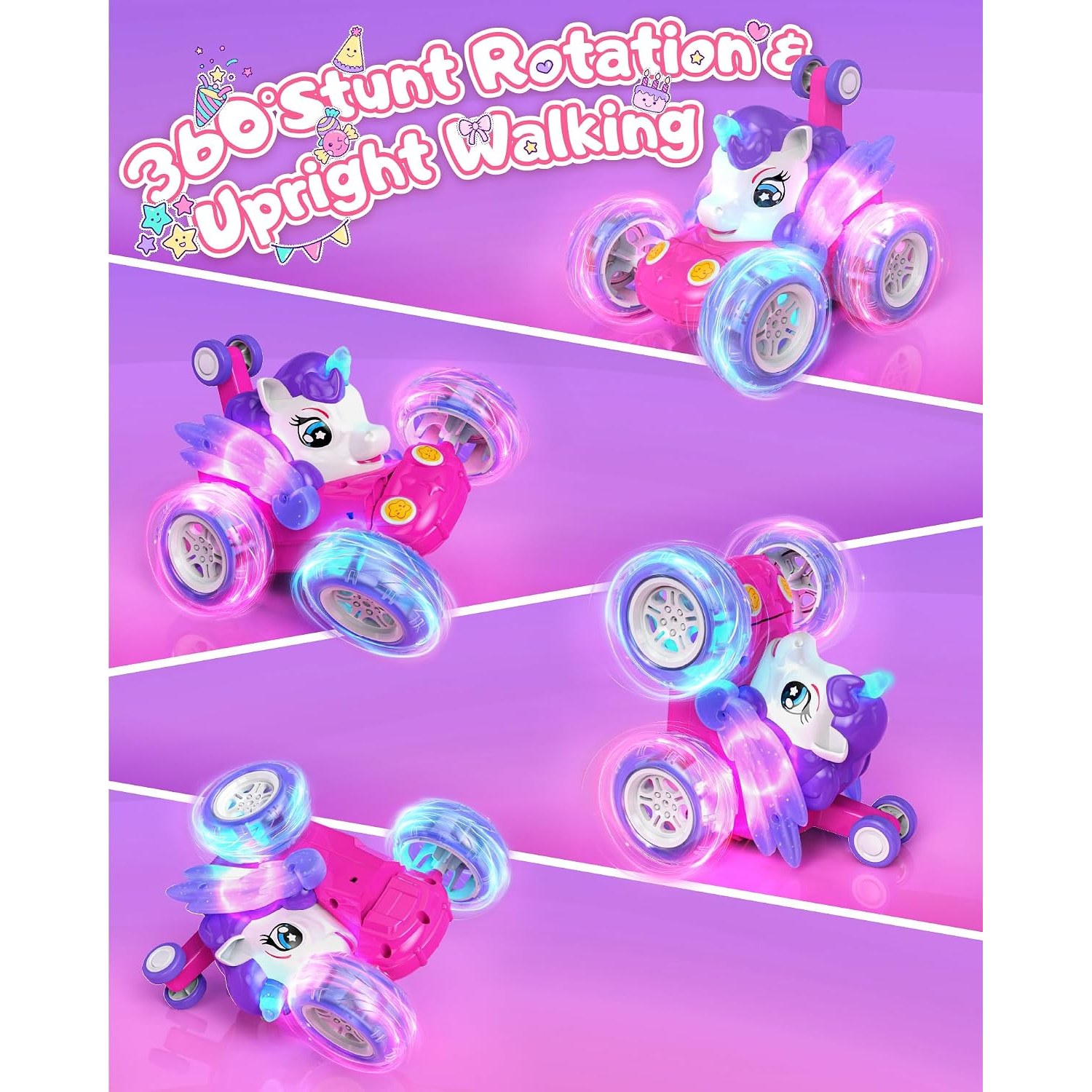
The basic driving is what you expect. Forward, backward, left, right. Where this type of car differs is in how it handles its own body. The wheels are oversized relative to the chassis, which lets it keep driving whether it is upright, on its side or upside down. Press the spin button and it whips through a 360 degree rotation. There is also an upright trick where it balances on two wheels and drives along like it is standing up.
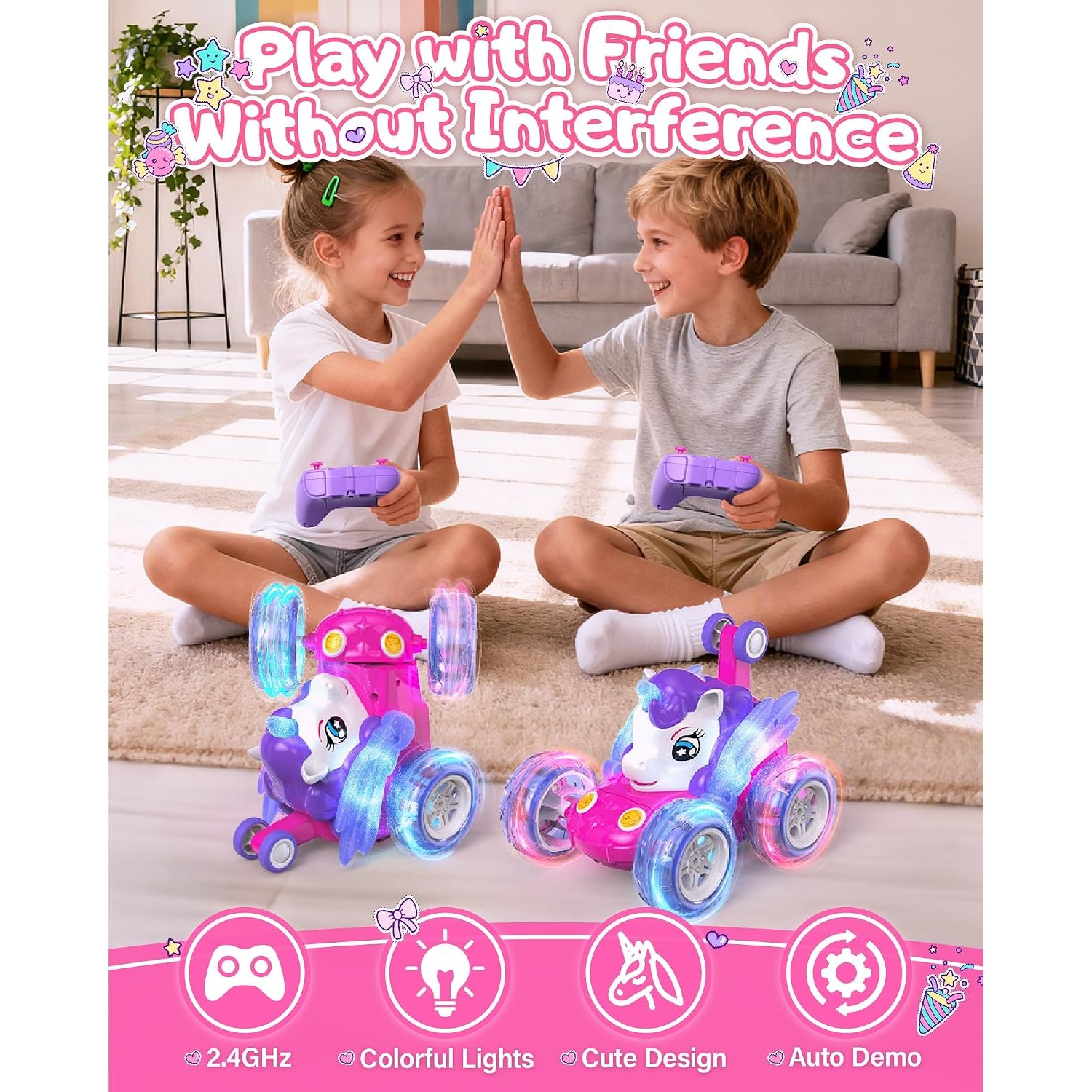
The control link is 2.4GHz. Older cheap RC toys ran on simple radio frequencies that clashed if two cars were nearby, so one remote would suddenly steer someone else's car. 2.4GHz pairs each remote to one car, which is why multiple units can run in the same room. It also gives better range, up to 40 metres here, and a quicker response between pressing a button and seeing the car move. That lag is one of the hidden reasons kids lose interest in cheaper toys, so it is worth noticing.
LED lights run while the car drives. During the day they are a nice detail. In the evening they are the main event. A lot of families find this toy gets its best sessions in a dim hallway or on a paved court after dinner, where the light trail from the spins is genuinely good to watch.
Automatic mode and why it matters more than it sounds
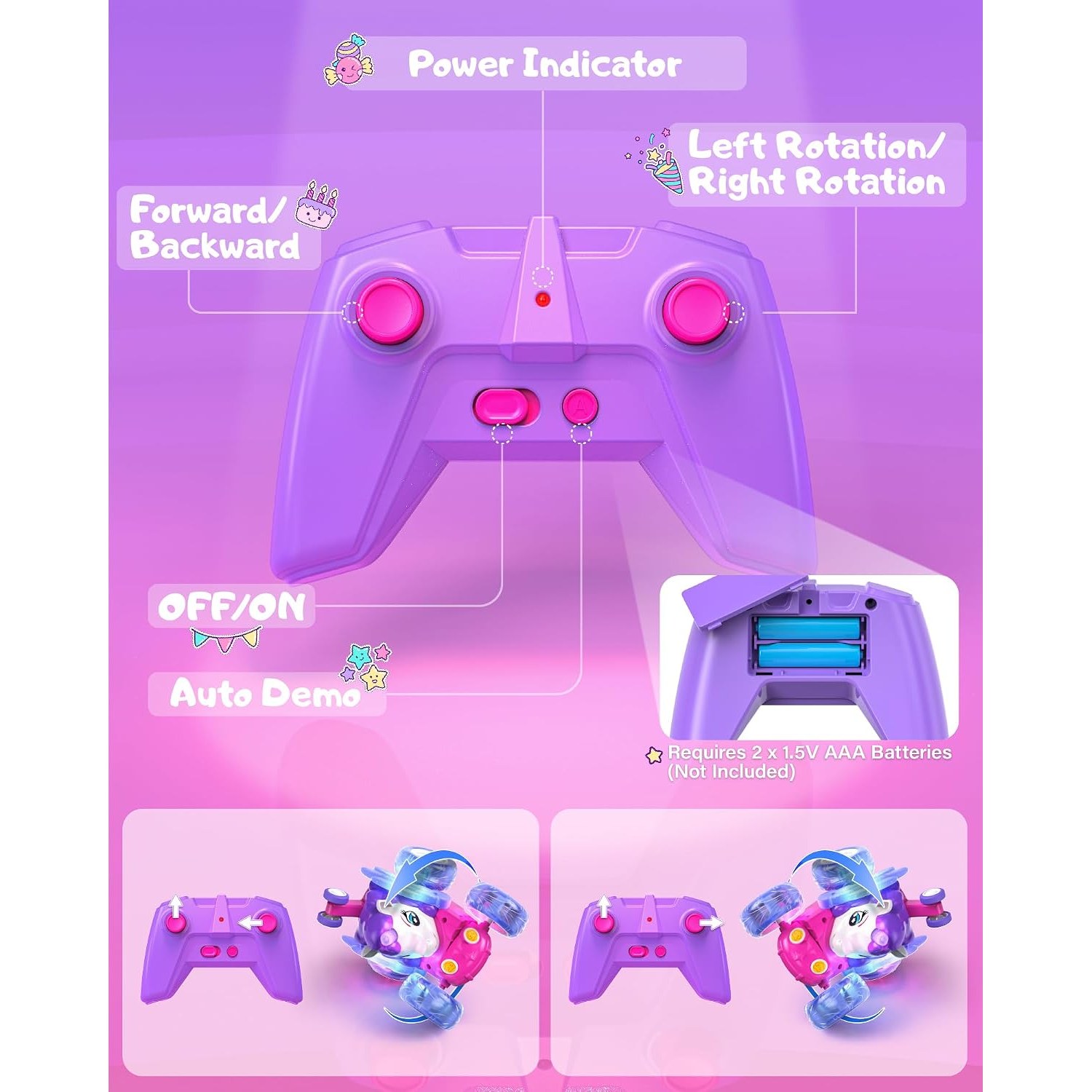
One button sends the car off on its own routine. Turns, spins, the upright walk, all sequenced without anyone holding the remote. It runs for about two minutes and then stops by itself if nobody intervenes. Press any direction on the remote and it hands control straight back.
This solves a real problem. The gap between a child wanting a remote control car and a child being able to drive one is usually a year or more. Automatic mode closes that gap. A three year old can press one button and get the full show. Meanwhile an older sibling or a parent can take over the manual controls without changing anything. For a mixed age household, that flexibility is worth a lot.
It also helps at parties and on first-day excitement, when a dozen hands want a turn and nobody is patient enough to learn the steering yet.
Who this suits, and who it does not
This fits children roughly between three and eight, with the sweet spot sitting around four to six. The age range description is 3 to 6 years and the manufacturer's recommendation runs from 36 months to 8 years. Below three, it is not appropriate, and that is a safety line rather than a preference.
The unicorn theme and pink colouring were designed with girls in mind, and it is commonly bought as a unicorn gift for girls. That said, nothing about the driving changes based on who holds the remote. If a child likes spinning lights and stunts, the theme is the only question.
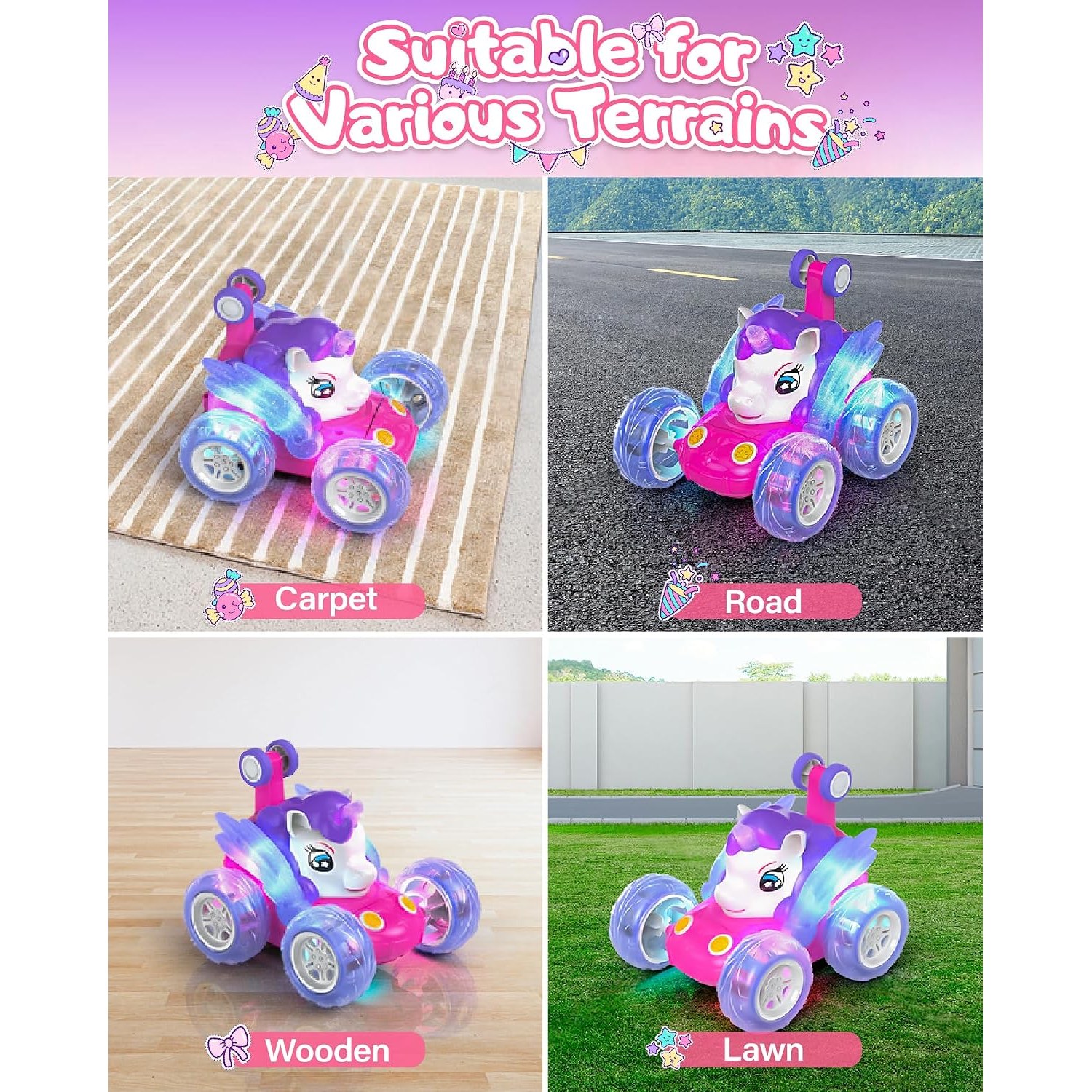
It will not suit an older child who wants speed. This is a stunt and trick car, not a hobby grade racer. If someone has outgrown tumble tricks and wants to time laps, look at a dedicated racing model instead. Similarly, if the only available space is long grass or a sandy patch, the stunts will not perform. This needs firm, reasonably flat ground to do its best work.
How to choose between stunt cars
A few things separate a good indoor remote control car from a disappointing one.
Check the control frequency. 2.4GHz is the baseline you want. Anything vaguer in the listing often means older technology with range and interference problems.
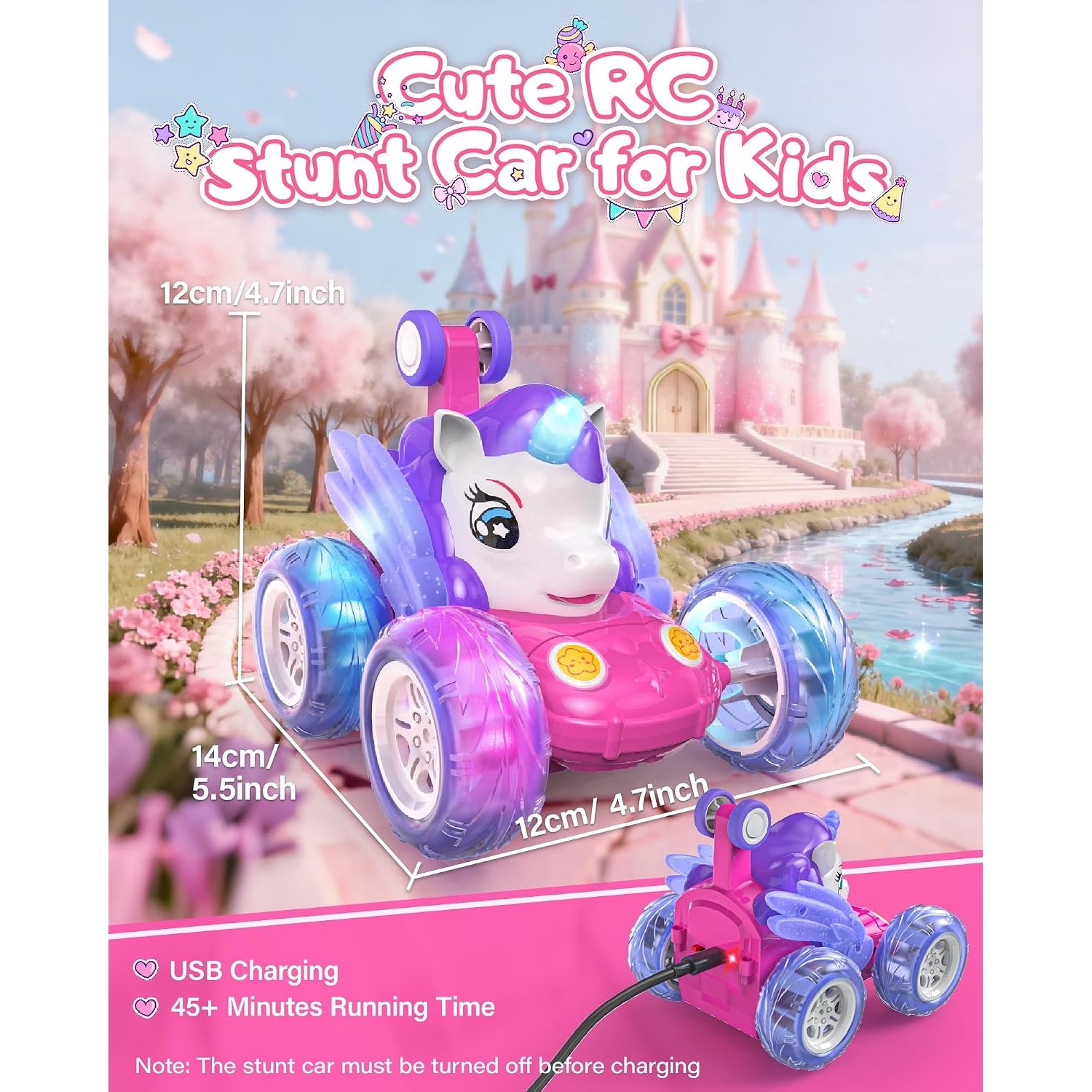
Check how it charges. A USB rechargeable RC toy saves you money and hassle compared to anything that eats AA batteries. Look at the two numbers that matter, charge time and run time. Here that is roughly 90 minutes to charge and over 45 minutes of driving, which is a sensible ratio for a toy this size.
Check whether the remote needs its own batteries. Most do, and most do not include them. This one needs 2 x 1.5V AAA and they are not supplied. Having them ready on gift day is the difference between instant joy and a trip to the shop.
Check the size against your space. At 14 x 12 x 12 cm, this is a compact car. That suits flats, hallways and small courts better than a larger buggy would.
Setting it up on day one
There is light assembly involved, which mostly means fitting the AAA batteries into the remote. A small screwdriver comes in the box for the battery door. That screwdriver is a tool, not a toy, so an adult should do the job and then put it away with the household tools.
Charge the car fully before the first session. The car must be switched off before you plug the USB cable in. Once it is charged, unplug it rather than leaving it sitting on the cable.
Then start indoors on a hard floor. Hard flooring gives the cleanest spins and the most reliable upright balance, so it is the best place to learn what the car can do. Move outside to a paved court or path once the basic steering is solid.
Looking after it
Care is straightforward. Wipe the body with a dry or slightly damp cloth and keep water away from the electronics. After outdoor play, check the wheels and pull out any grit, hair or grass that has wound around the axles. A blocked axle makes the motor work harder than it should.
Store it inside, out of damp and away from heat or direct sun. If it is going into a cupboard for a month or more, take the AAA batteries out of the remote first. Battery leaks are a quiet way to kill an otherwise fine toy.
With charging, normal habits are enough. Charge it when it slows down, unplug it when it is done, and avoid storing it completely flat for long periods.
The short version
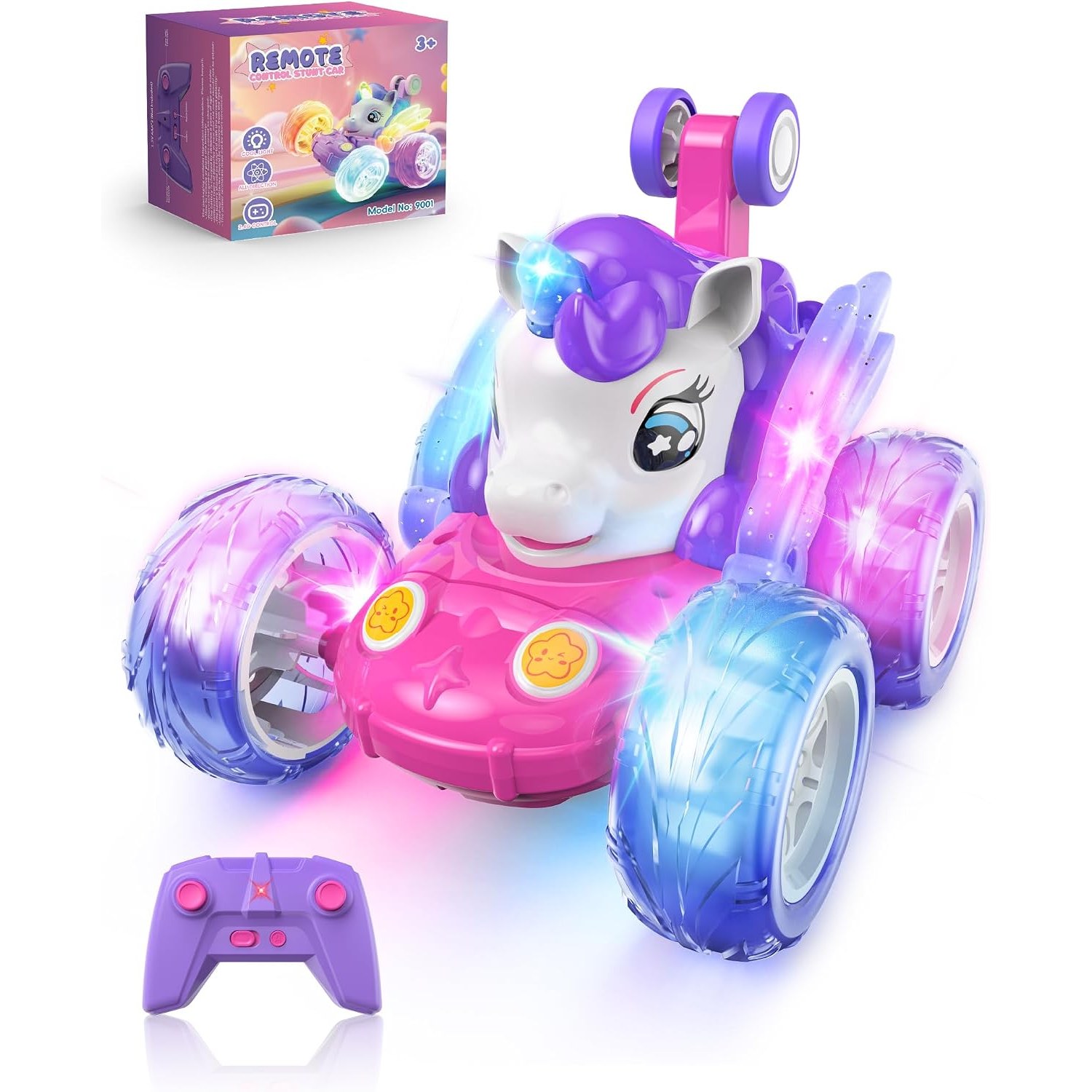
This is a pink unicorn themed stunt car for roughly three to eight year olds, driven by a 2.4GHz remote with a 40 metre range. It drives in all directions, spins 360 degrees, drives upright and lights up with LEDs while it moves. An automatic mode runs its own routine for about two minutes so younger kids can join in before they can steer.
It charges by USB in around 90 minutes and runs for over 45 minutes. You will need two AAA batteries for the remote, since those are not included. It measures 14 x 12 x 12 cm, is made of plastic, and comes with a charging cable and a screwdriver.
If you want a toy that survives being flipped, recharges without a battery budget, and makes an obvious impression as a gift, this one earns its place. If you want speed and lap times, look elsewhere.