

The complete guide
Window Art Buying Guide, Choosing a Suncatcher Kit Kids Will Actually Finish
The craft kit problem every parent knows
You buy the box. There is a burst of enthusiasm on day one. By day three the pieces are scattered across the kitchen table, half the paint has dried in the lids, and nobody can remember what the finished thing was supposed to look like.
Most craft kits fail for one of two reasons. Either they ask too much, so a child hits a wall and quietly gives up, or they ask too little, so the whole thing is over in eleven minutes and feels disposable afterwards. The ones that work sit in between. They give enough structure that a child always knows the next step, and enough freedom that the result feels like theirs.
Window art lands in that middle zone unusually well, which is why it keeps appearing on lists of the best indoor art activity for primary age kids.
How window art works
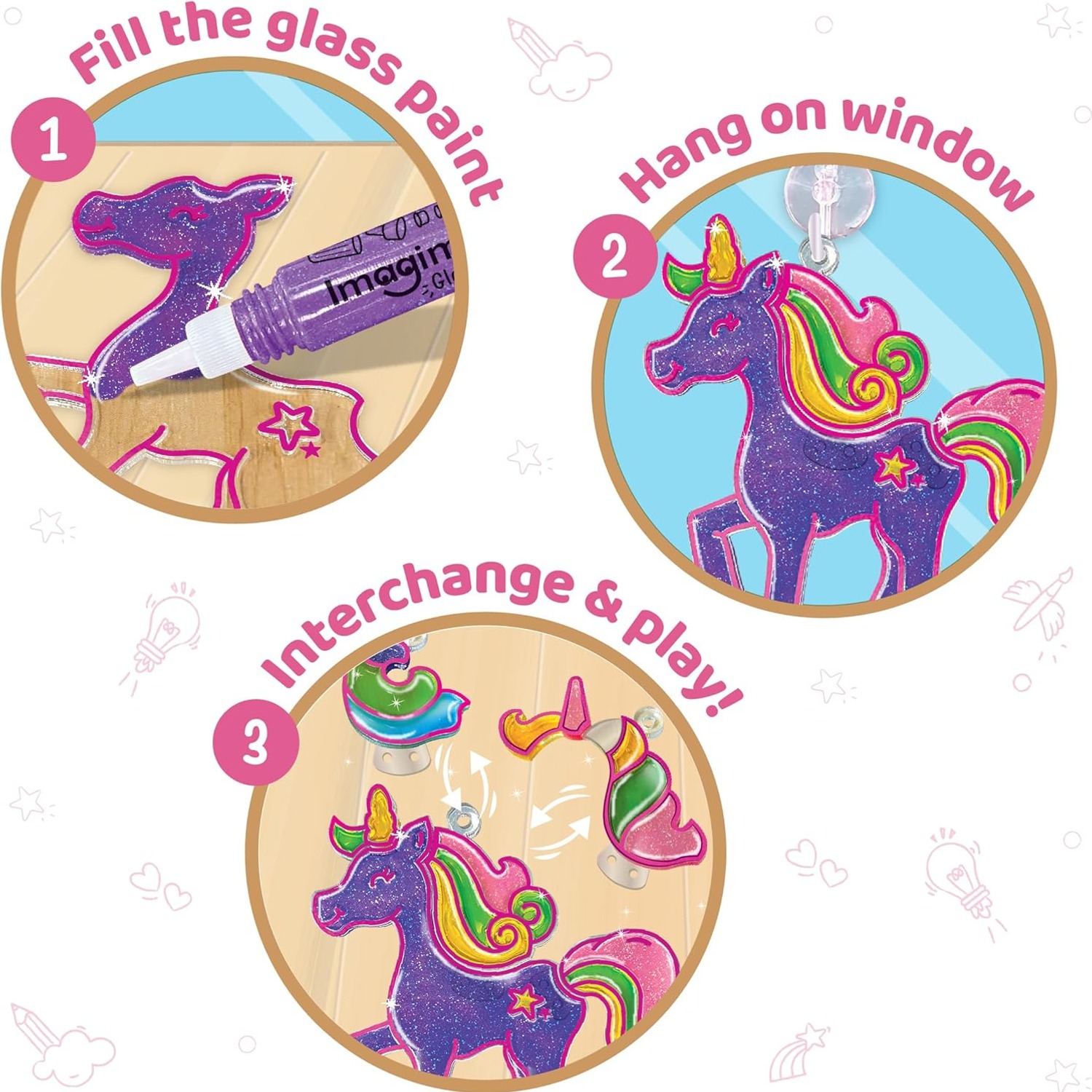
The idea is simple. Each suncatcher piece comes with raised outlines moulded into it. Those outlines divide the shape into sections, a little like a stained glass window. You squeeze glass paint into a section and let it spread to the edges, where the raised border holds it in place.
Then you wait. This is the part people rush, and it is the part that decides whether the finished piece looks sharp or smudged. Glass paint of this type needs hours to set, often overnight for thicker areas. A kit left to dry properly comes out glossy and translucent. A kit poked at too early comes out streaky.
Once dry, the pieces hang on a window with suction cups. Light passes through the paint, the colours come alive, and that is the payoff. A drawing on paper gets stuck to the fridge. A suncatcher changes depending on the weather and the time of day, so it stays interesting for weeks.
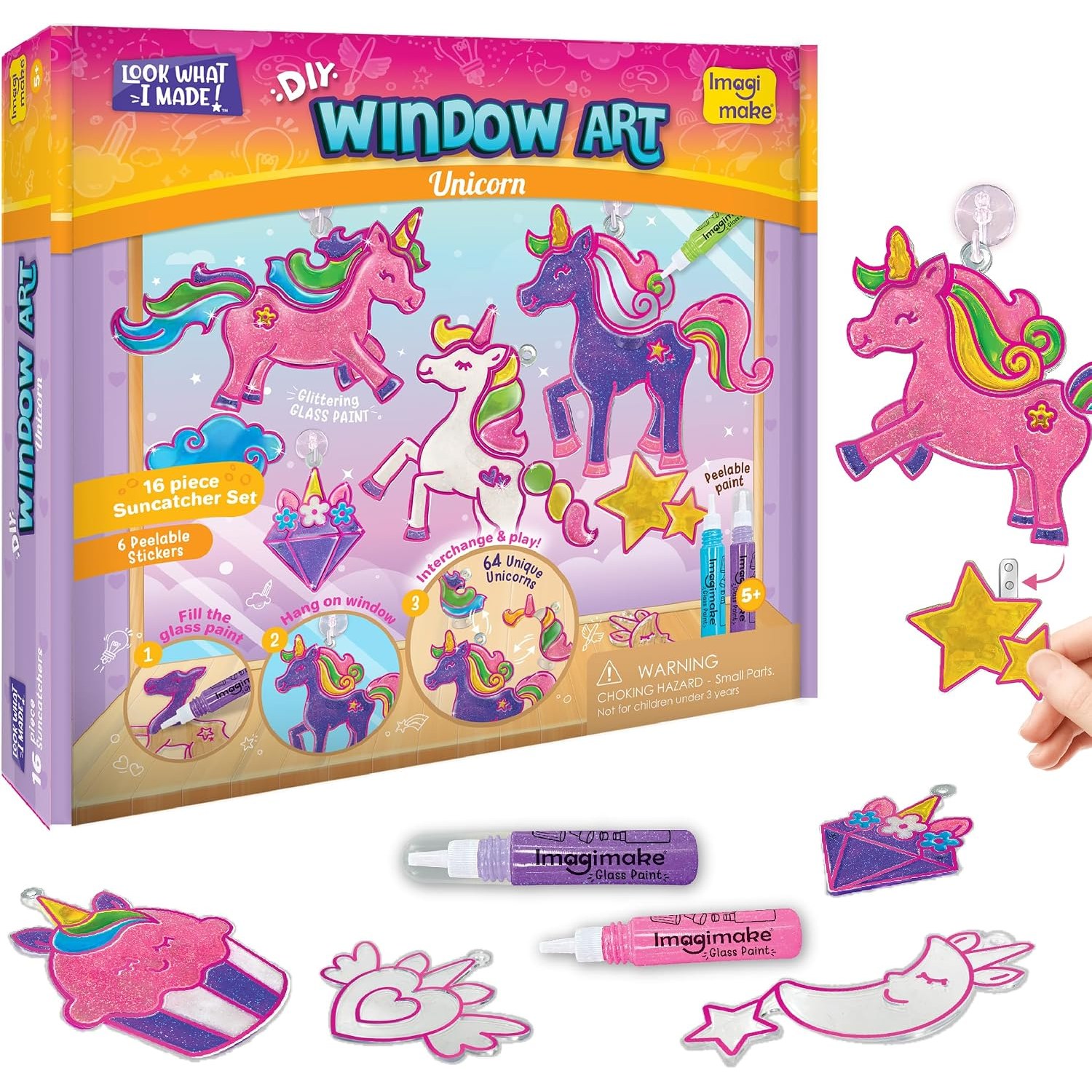
This particular Imagimake set adds a second payoff. The paint is peelable. Painted on the included acetate sheet rather than on a moulded suncatcher, a dried design lifts off in one flexible piece and works as a sticker. That turns the kit from a one-and-done project into something that keeps producing, especially when combined with the design book for fresh shapes to trace.
What is actually in this kit
Fifty-two pieces, which sounds like a lot until you break it down.
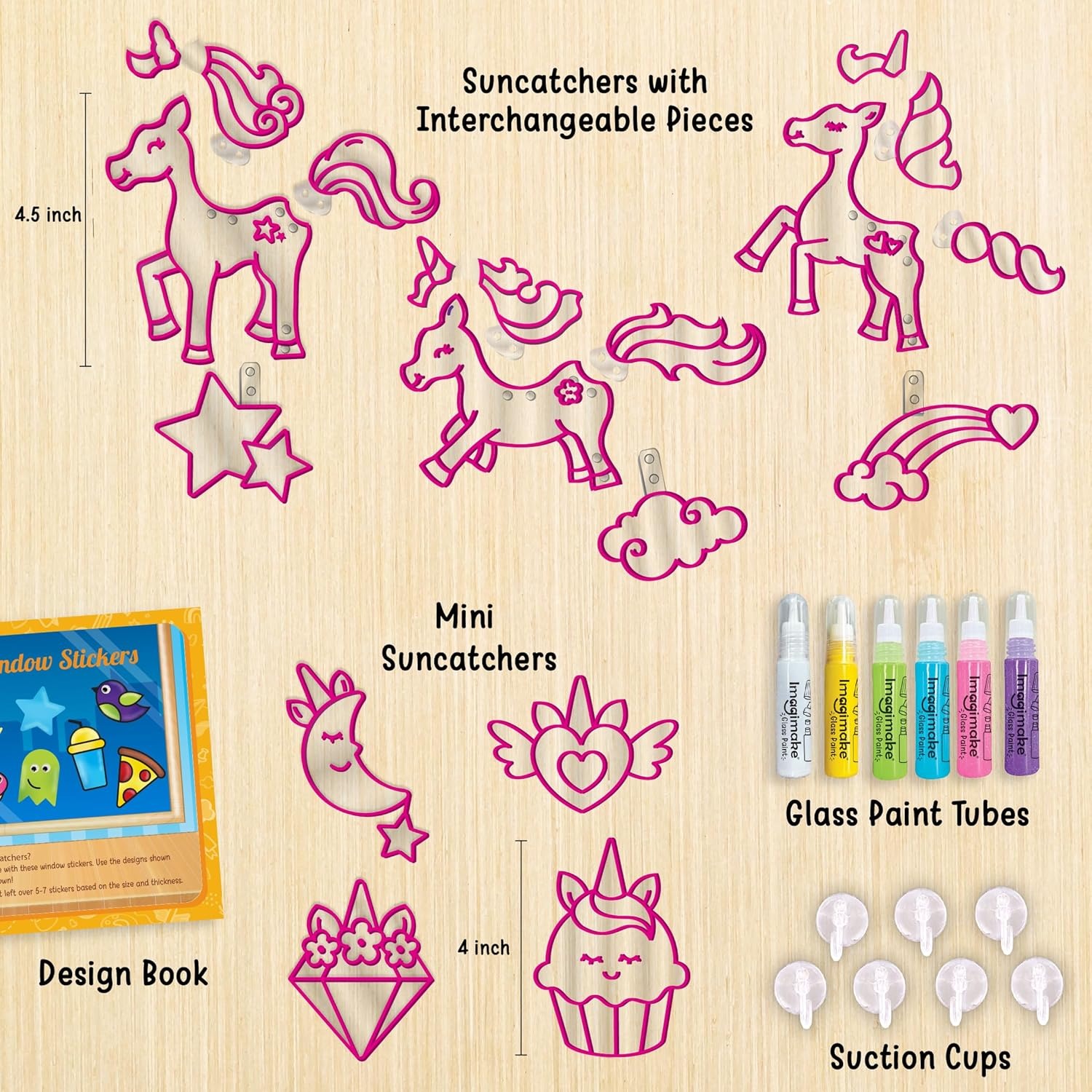
Twelve pieces build three unicorns, and those parts are designed to be interchanged. A head from one unicorn can be paired with a different body and tail, so the visual combinations go well past three. Four mini suncatchers in cupcake, diamond, heart and moon shapes handle the shorter sessions.
Eleven paint tubes provide the colour, including glitter shades, and one glass liner handles outlining for original work. Seven suction cups mean most finished pieces can go up straight away. The design book and acetate sheet are the ingredients for the peelable sticker side of things.
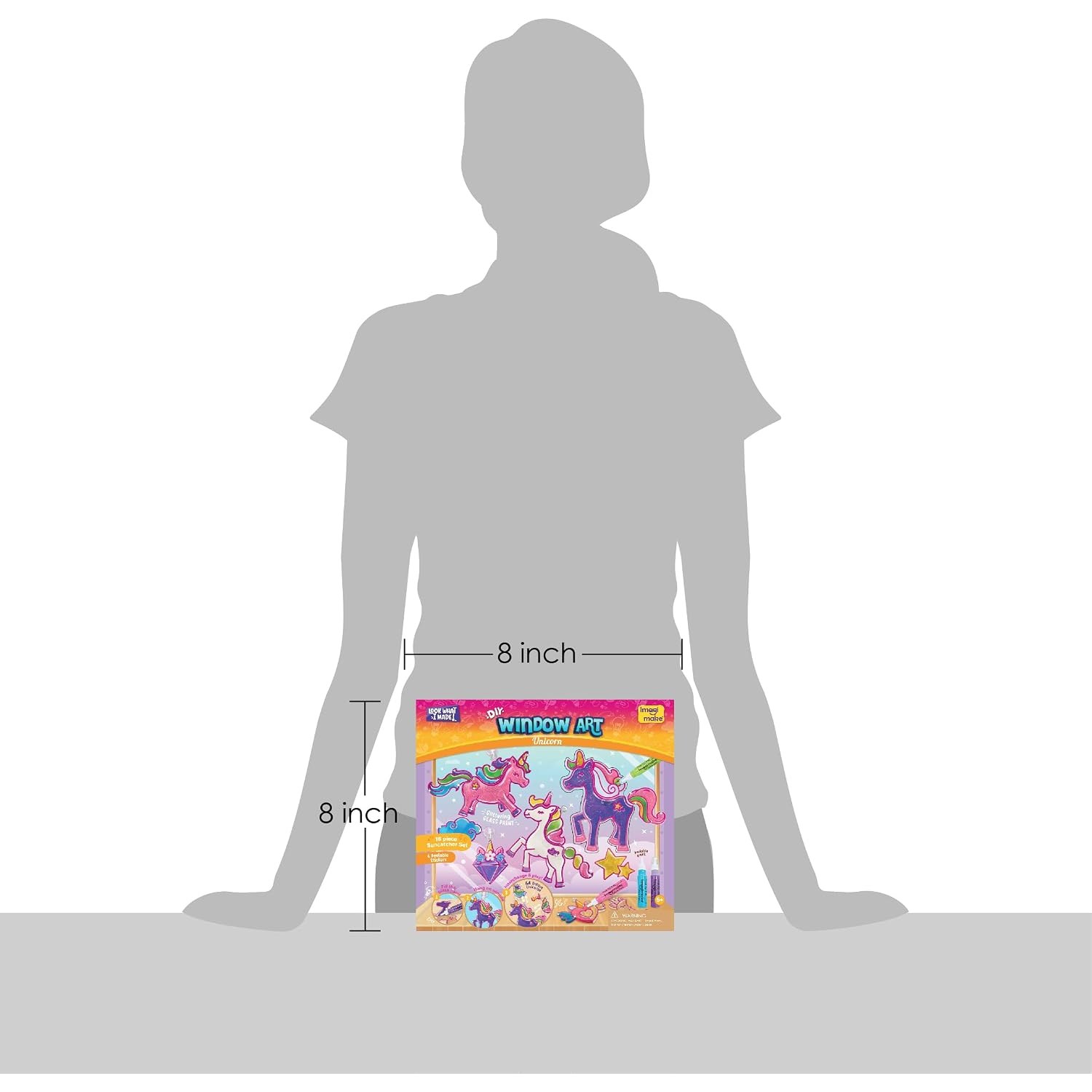
The box measures 31 x 28 x 5.5 cm and weighs 340 g. The paint is listed as non-toxic.
Who it suits
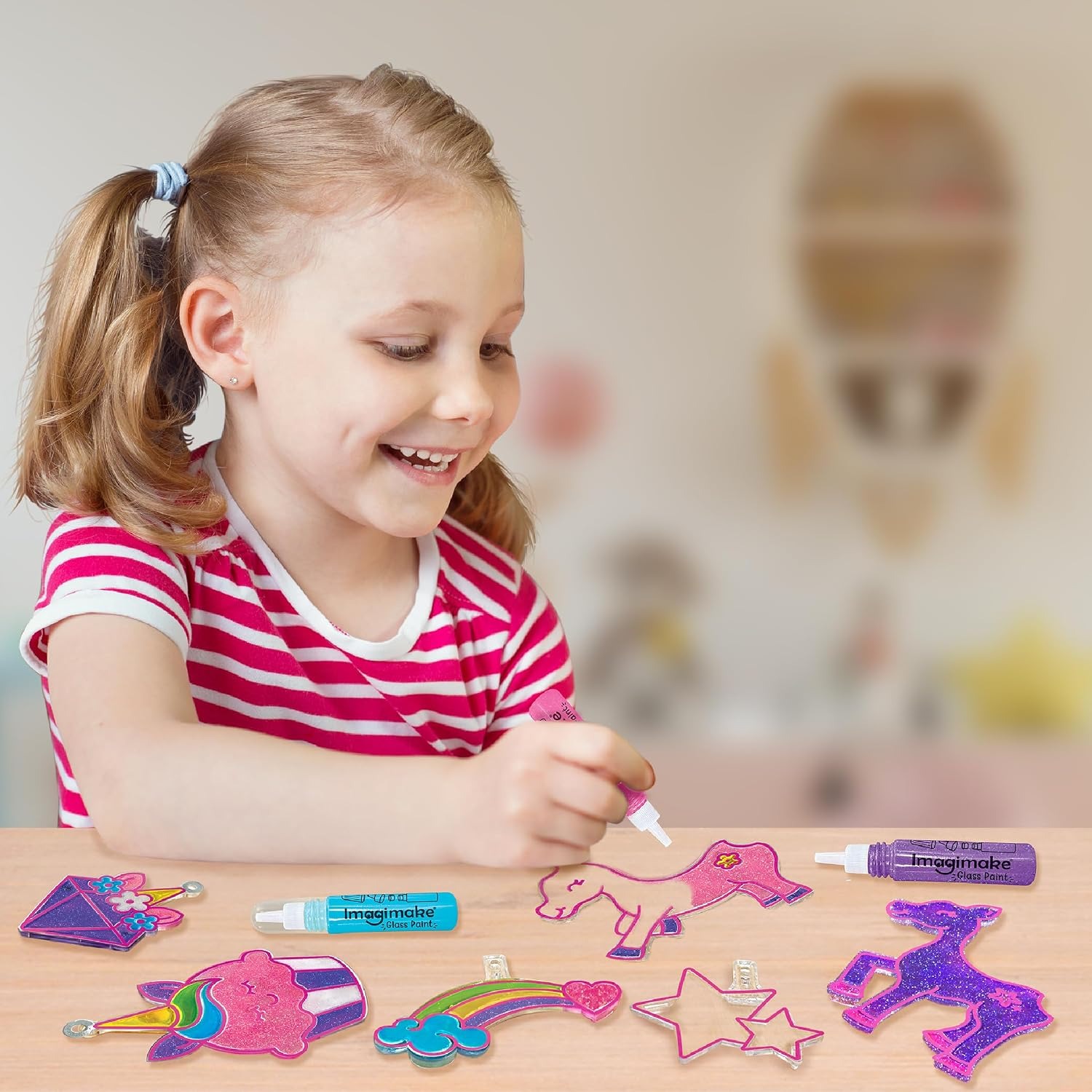
This is a primary school product. Around five or six, a child will enjoy it with someone sitting beside them, mostly to help judge how hard to squeeze a tube and to stop them touching wet paint. From about seven upward, most children can run the whole process themselves, which is when it becomes the best screen free activity in the house on a wet Saturday.
Older children, nine and up, tend to gravitate toward the acetate sheet. The moulded unicorns are a warm-up for them. The real interest is in designing their own shapes with the liner and peeling them off as stickers for a water bottle or a bedroom mirror.
It also works for two children at once. One takes the unicorns, the other starts the minis, and they trade colours. Just be aware the paint tubes will empty faster with two sets of hands.
Who is it not for? Children under three, because of small parts. And a child who genuinely dislikes waiting. The drying time is non-negotiable, and if patience is in very short supply, pick something with an instant finish instead.
How to choose between window art kits
A few things separate a decent kit from a frustrating one.
Count the paint, not the pieces. A kit advertising a big piece count means nothing if there are four paint colours to cover all of them. Eleven tubes plus a liner is a generous ratio for seven main shapes.
Look for interchangeable parts. A set of fixed shapes gets painted once and that is the end. Swappable heads, bodies and tails give a reason to come back.
Check whether suction cups are included. It is a small thing that gets left out surprisingly often, and a finished suncatcher sitting on a shelf is a disappointment compared to one on the glass.
Decide if you want peelable paint. Not every kit has it. If you do, you get sticker-making on top of suncatcher-making, and the kit stretches much further.
Mind the mix of project sizes. All-large kits stall. All-small kits feel slight. Having both full unicorns and quick minis gives a child a choice depending on their energy that day.
Setting up for a good session
Clear a table and cover it. Newspaper or a wipeable mat is fine. Dried glass paint on a wooden table is annoying to remove, and prevention takes twenty seconds.
Set out all eleven tubes where they can be seen. Children choose better colours when the whole range is visible rather than buried in the box.
Start with a mini suncatcher. The cupcake or the heart takes maybe twenty minutes and teaches the squeeze-and-fill rhythm before committing to a full unicorn. It also means there is a finished piece on the window by the end of the first day, which matters more than you would think for motivation.
Then stop. Leave everything flat to dry overnight, ideally somewhere out of reach of younger siblings. Come back tomorrow for the next piece.
Looking after the kit and the finished work
Cap the paint tubes and store them upright. Most dried-out tubes are the result of a lid left off, not a faulty product. If a nozzle clogs, a pin usually clears it and the paint underneath is still fine.
Finished suncatchers need very little. Dust them with a dry cloth now and then. Avoid cleaning sprays and avoid soaking them, since water and household cleaners can cloud or lift the paint.
Suction cups lose grip over time, mainly because of finger grease. Rinse them in warm water, dry them, and press them back onto a clean window. Seven cups in the box means there is room to rotate them.
Peeled stickers can usually be repositioned a few times. Keep them on smooth surfaces. Glass, mirrors, glossy tiles and plastic lids all hold them. Painted walls and fabric do not.
The short version
This is a well-stocked unicorn window art kit with enough paint to actually finish what it contains. The interchangeable unicorn parts and the four mini suncatchers give both long and short projects, so it fits different moods and attention spans. The peelable paint and acetate sheet add a second life to the kit once the moulded pieces are done.
It suits roughly five to eleven year olds, works best when you accept the overnight drying rather than fight it, and makes a tidy gift at 340 g in a 31 x 28 x 5.5 cm box.
If your child likes colour, likes making things that other people can see, and can live with waiting a night for paint to set, this is a solid pick. If they want an instant result, look at something else in the range and we will happily point you toward it.