
The complete guide
Choosing a Stunt RC Car That Survives Real Kids
The problem with most remote control cars
Buy a cheap remote control car and you usually learn the same lesson within an hour. The car hits the skirting board, flips onto its roof, and lies there with its wheels in the air. A child who is six years old does not care about torque curves or tyre compounds. They care that the fun stopped and now they have to walk across the room.
That one weakness kills more RC cars than any mechanical fault. The toy gets slower to pick up, then it gets left in the cupboard. Add a single battery pack that runs flat in fifteen minutes and you have a toy with a very short life in the house.
A double sided remote control car fixes the biggest part of that. Both faces drive. Flip it, roll it, send it off a ramp and land it any way up, and it carries on. Crashing becomes a trick rather than a stoppage, which is exactly the right message for a kid learning to steer.
How a double sided stunt car works
The build is simple once you see it. Instead of a chassis with a decorative shell on top, the car has two usable faces and oversized wheels that stick out past both of them. Whichever way up it lands, the tyres are the lowest point and they have grip.
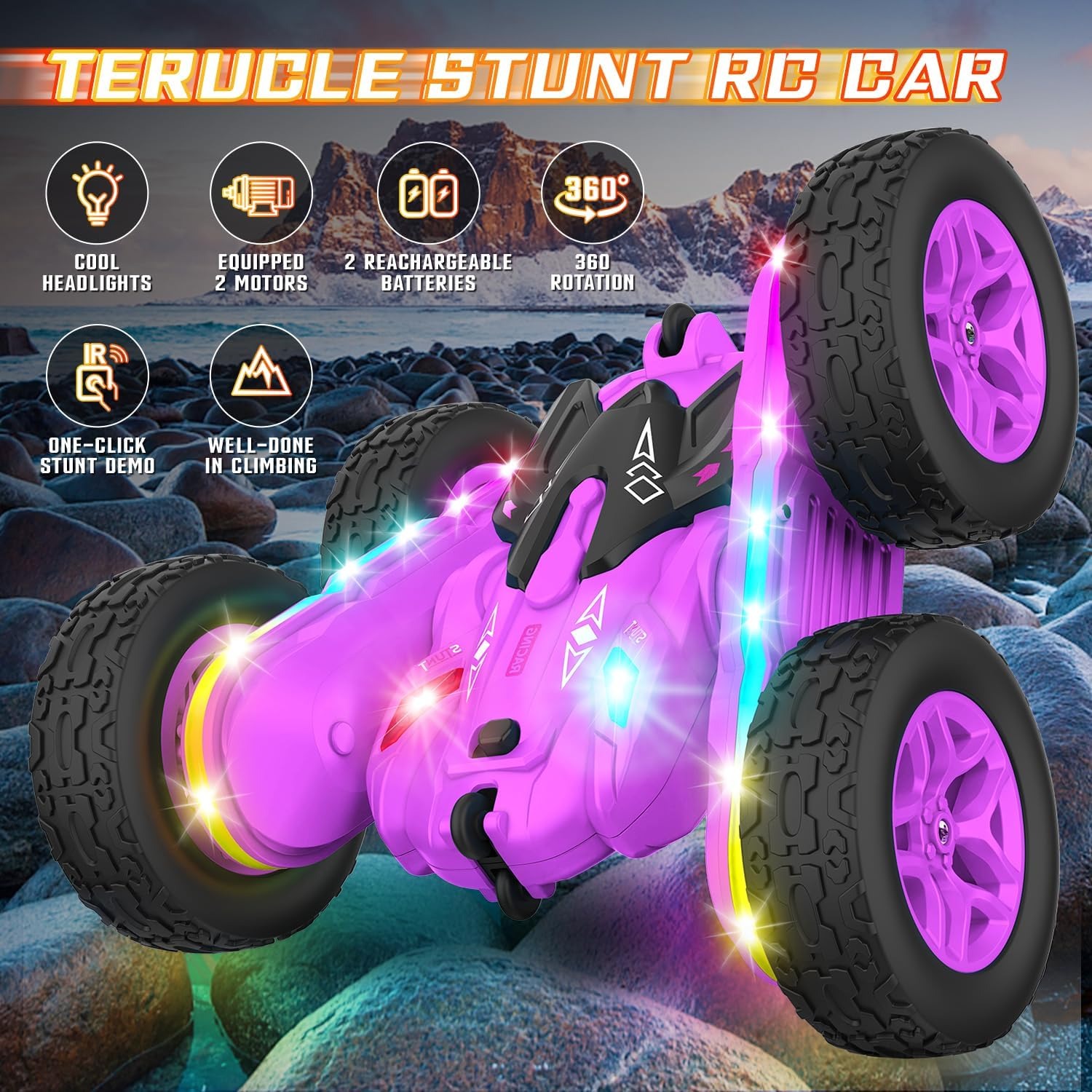
Spinning comes from the same design. Drive one side forward and one side back and the car rotates on the spot, which is how you get a full 360 degree stunt car rather than one that just does wide circles. On smooth floors the spin is fast and clean. On carpet it slows down and bites in, which some kids actually prefer because it looks more like a drift.
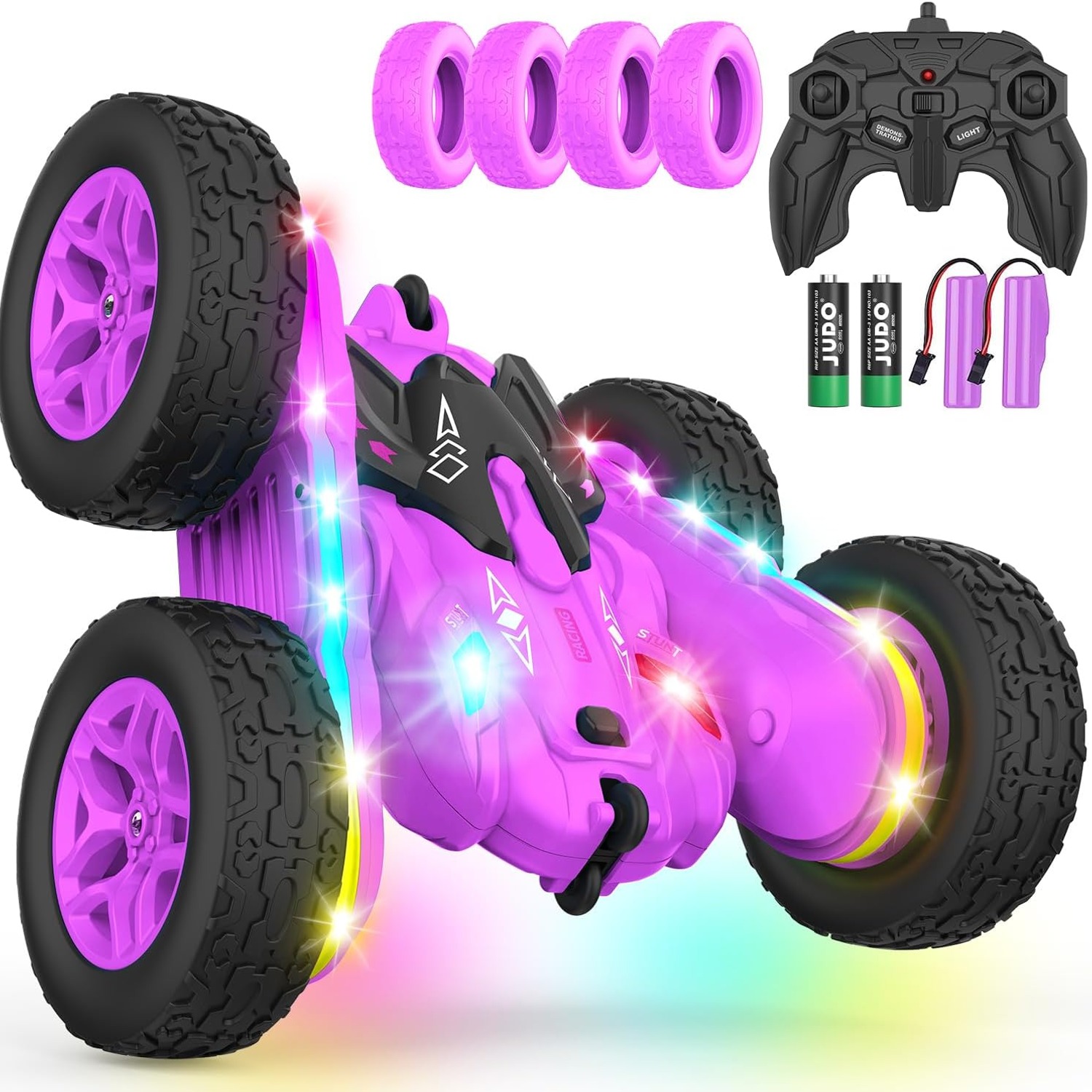
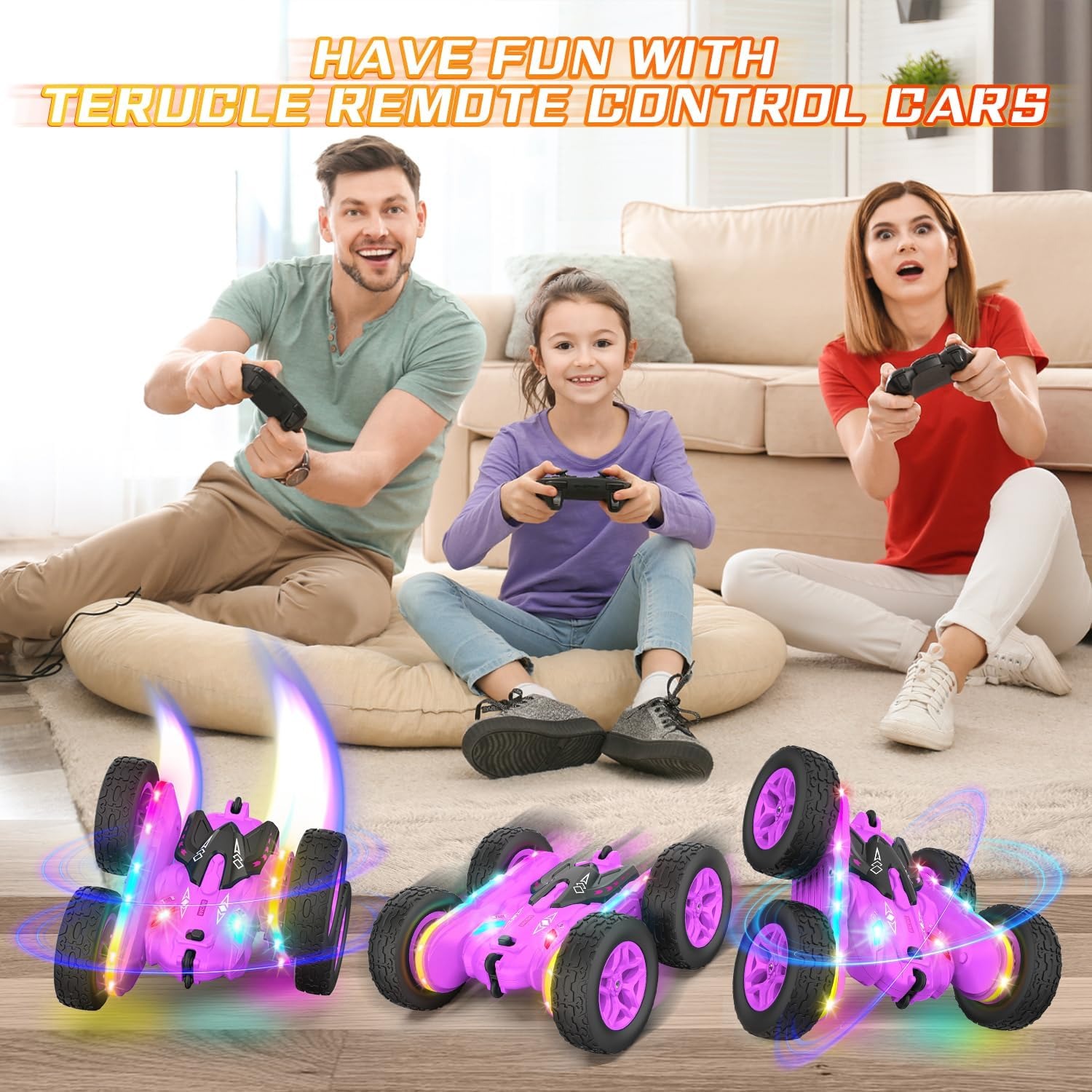
The light strips sit along the body and run through seven colours, flashing at different rates while the car moves. It is a cosmetic feature, but it does real work. A glowing car is easy to track across a dim paved area, easy to find under the sofa, and much more interesting to a child than a static plastic body.
There is also a demonstration button. Press it and the car runs its own stunt routine with nobody steering. That matters more than it sounds for a first-time driver, because it gives an immediate result while the child is still getting used to the controller.
Who it suits
The recommended age is 6 years and up, and that feels about right. At six, most kids can handle a two-stick controller, understand that pushing forward goes forward, and cope with the car not going exactly where they aimed it.
It suits children who play rough. The listed features include anti-skid, shock resistant and flashing light, and the double-sided design means ordinary crashes are part of normal use rather than damage.
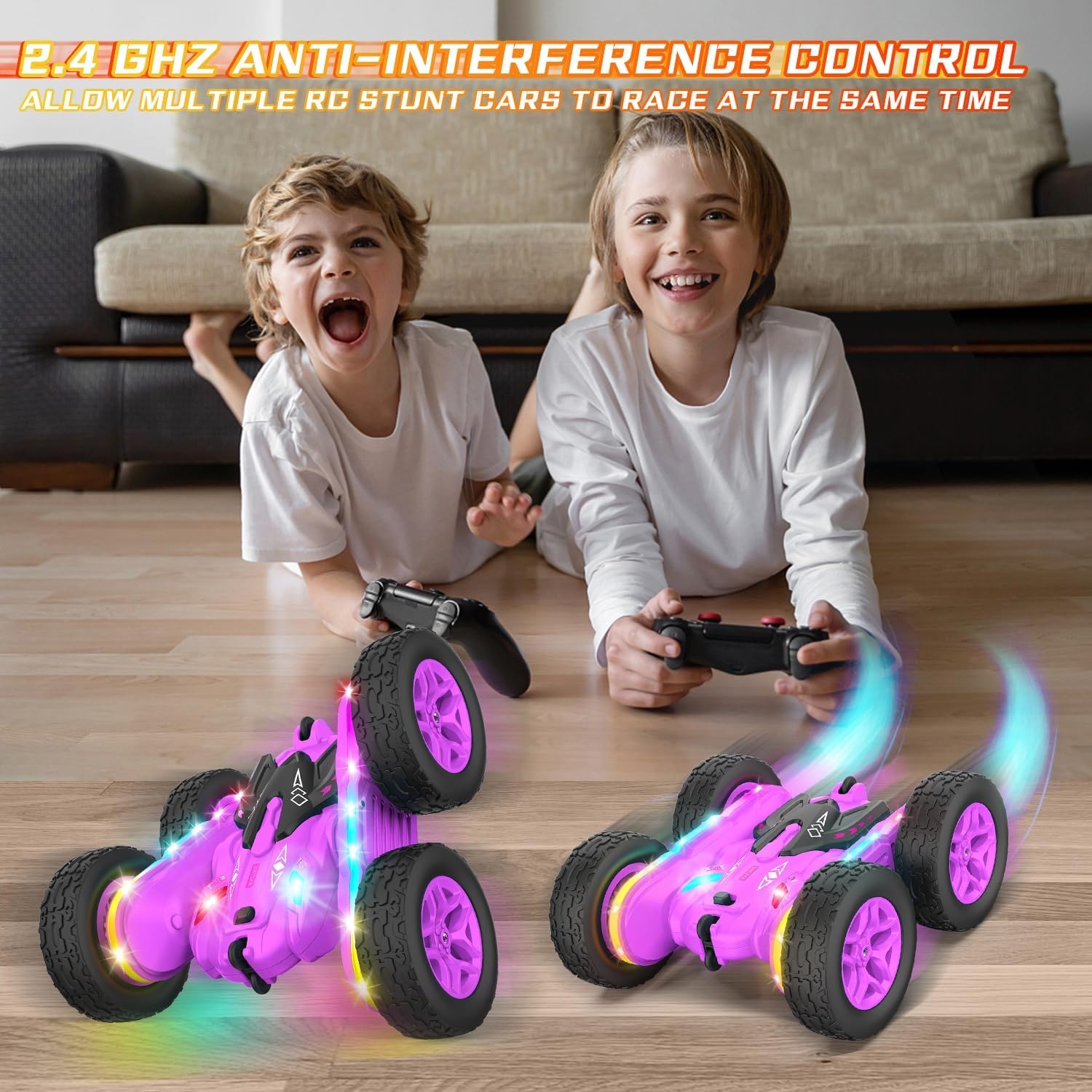
It suits households with more than one child. Because the controller runs on 2.4GHz, two or more cars can be driven in the same room without one controller hijacking the other car. That used to be a real problem with older toy radios. If you are buying the best double sided rc car for siblings, buying two is a genuinely workable plan.
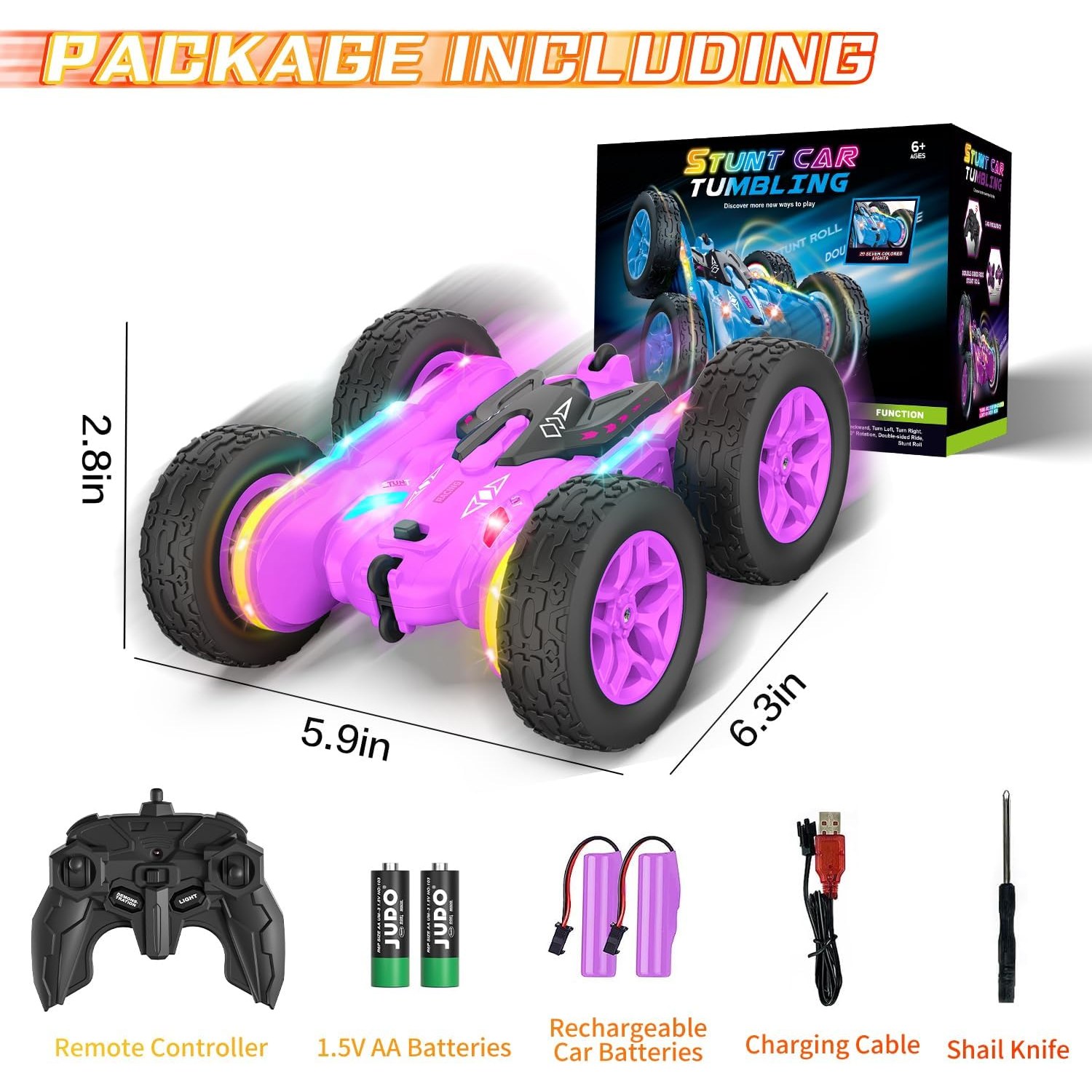
It suits anyone who is tired of toys that need four AA batteries you do not have. Two rechargeable packs for the car and two AAs for the controller are in the box.
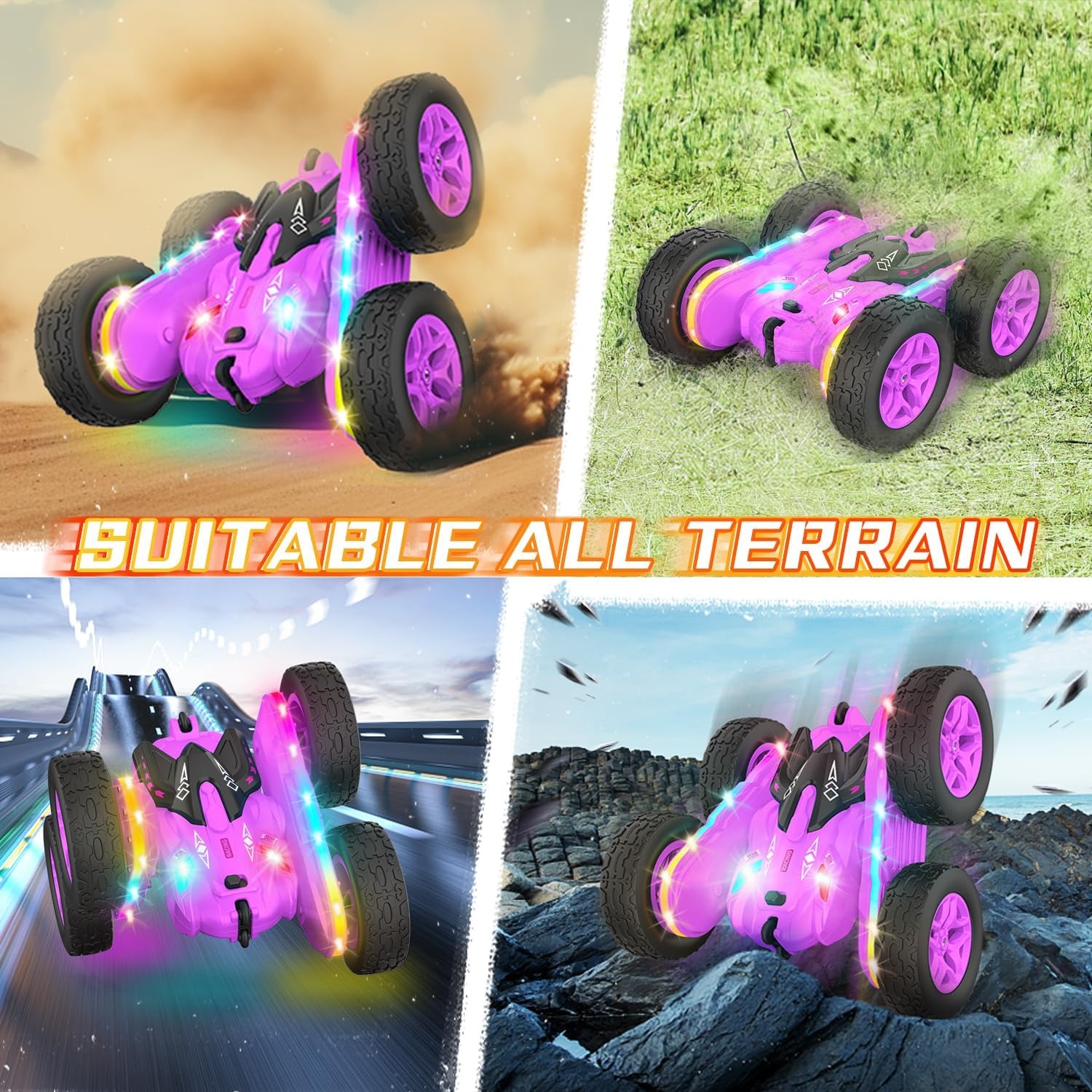
It is less suited to rough outdoor terrain. Sand, mud, gravel and long grass are not its environment. Paved courts, footpaths and indoor hard floors are.
How to choose between stunt cars
A few things actually matter when you are comparing models, and a few things do not.
Battery count. This is the single biggest factor in how much the toy gets used. One pack means a short session and a sulk. Two packs mean you charge one while the other runs. Anything described as the best rechargeable remote control car should include a spare pack, not just promise a long run time.
Spare tyres. Tyres are the part that wears and the part that gets chewed by a dodgy floor transition. Four replaceable tyres and an assembly tool are included here, which means a worn wheel is a five minute fix rather than the end of the toy.
Control frequency. 2.4GHz is the standard you want. It avoids interference and allows group racing.
Size. At 19.1 x 10.2 x 14 cm and 0.62 kg, this one is a middle-sized car. Big enough to feel substantial and to handle a hallway at speed, small enough to live in a toy box and travel in a bag. Very large stunt cars look impressive online and then turn out to be too fast for an indoor space.
Lights. Optional on paper, important in practice. A light up rc car gets used at times of day when a plain one gets ignored, which is most evenings after dinner for a lot of families.
What matters less than the marketing suggests is top speed. A toy that is too fast indoors just gets banned indoors.
Getting the best out of it
Start on a hard floor with a clear run of about three metres. Let the child drive forward and back only for the first few minutes, then add turns, then add spins. Trying stunts straight away usually ends with the car wedged under a bookshelf.
Charge both packs before the first session so there is no gap. Label them if you can, even with a dot of marker, so nobody loses track of which one is flat.
Check the axles every few sessions. Hair and carpet fibre wrap around them and quietly rob the car of speed. A pair of tweezers and thirty seconds usually fixes a car that seems to be dying.
For outdoor runs, pick a surface you would be happy to walk barefoot on. If it is gritty enough to hurt your foot, it is gritty enough to get into the drivetrain.
Set a house rule about where it can be driven. The best indoor rc stunt car in the world will cause arguments if it keeps hitting the TV cabinet.
Care and storage
Cleaning is quick. Wipe the body and the tyres with a dry or barely damp cloth, then pick any debris off the wheels and axles. Never run it under a tap or hose it down, and do not use solvent cleaners on the plastic.
Charge with the cable supplied and with an adult nearby. Keep charging on a hard surface and away from bedding or soft furnishings, and unplug when it is done. If the car will not be used for a few weeks, take the pack out and store it somewhere cool and dry rather than leaving it sitting in the car.
Keep the spare tyres and the assembly tool with the box. These are the parts that go missing first, and the car is far more useful over a couple of years if you still have them.
The short version
This is a stunt car built around one good idea. It drives on both sides, so crashing does not end the game. Everything else supports that: the 360 degree spins, the shock resistant plastic, the spare tyres and the second battery pack.
The colour-changing light strips are what sells it to a child, and they earn their place by making the car fun after dark and easy to find afterwards. The 2.4GHz controller means it works in a house with more than one car running.
Age 6 and up, 19.1 x 10.2 x 14 cm, 0.62 kg, purple with strip lights, plastic body, two rechargeable packs and two AAs included. If you want a remote control car that is still being played with in six months rather than one that stalled on its roof in week one, this is a sensible place to spend the money.